You are traveling in Japan when a tooth suddenly starts hurting.
Perhaps you wake up with severe pain. A filling may come out during dinner. A crown may break. Your gum may become swollen. Or you may fall while sightseeing and damage a front tooth.
You find a dental clinic and remember:
“I have travel insurance. Will it cover this?”
At first, this sounds like a simple yes-or-no question.
At a dental reception desk, however, several different questions are hidden inside it.
Does your policy include dental treatment at all?
Does it cover dental disease as well as accidental injury?
Does it cover only emergency pain relief, or can it also cover definitive treatment?
Is dental care eligible for direct billing?
Do you have to pay the dentist first?
Is there a separate dental benefit limit?
What documents will the insurer require afterward?
Travel insurance may cover dental care in Japan, but dental coverage is often more limited than general medical coverage, and the details can vary substantially between insurers, plans, countries or regions of residence, and individual policy wordings.
The most important point to understand from the beginning is this:
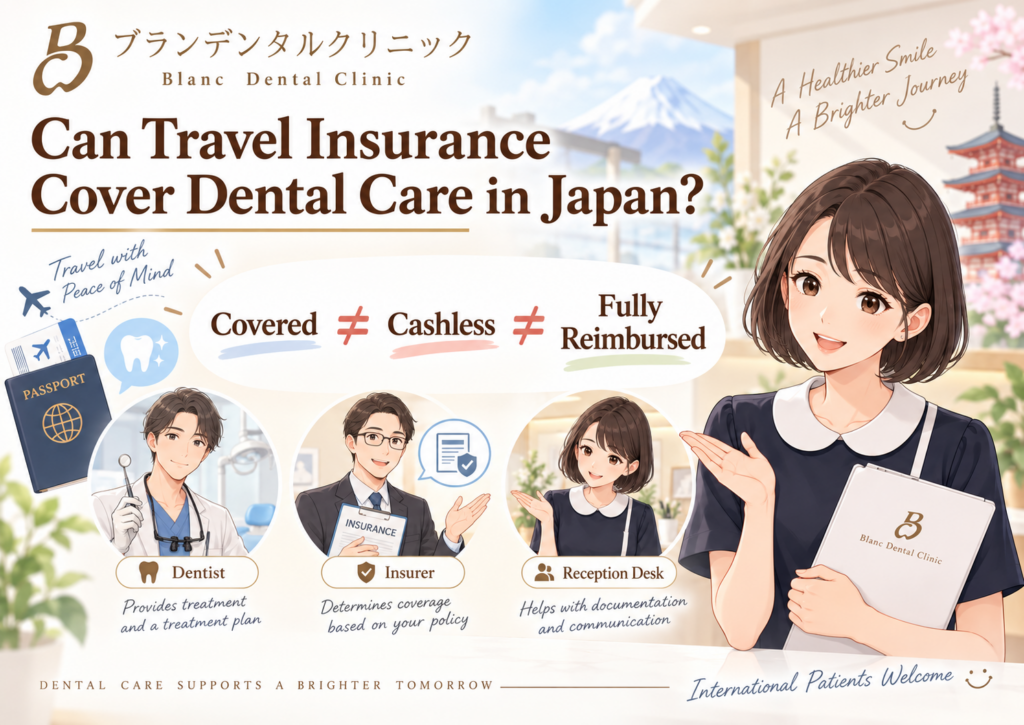
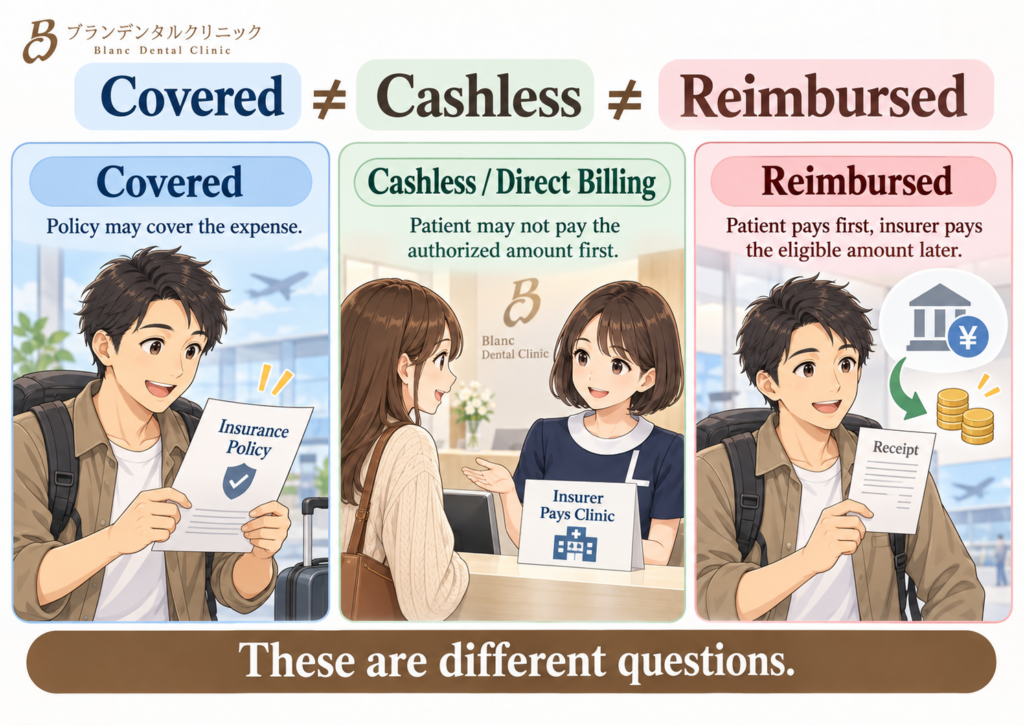
“Covered,” “cashless,” and “fully reimbursed” do not mean the same thing.
There is another distinction that is just as important:
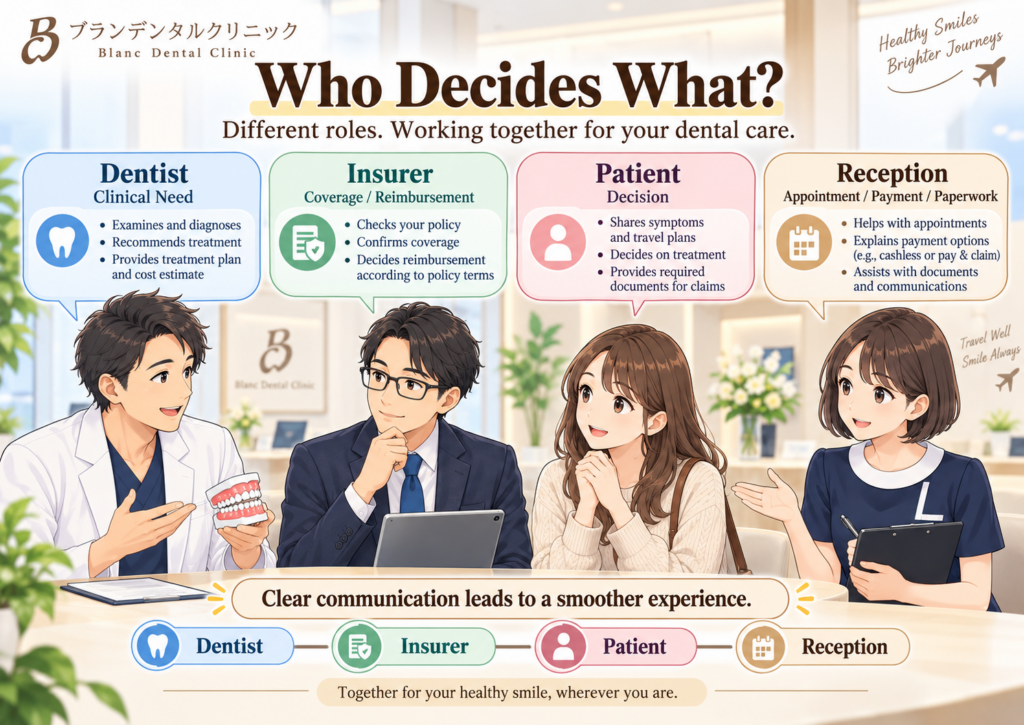
The dentist decides what treatment is clinically necessary. The insurer decides what the insurance contract will pay.
This article explains the practical process from the reception desk: what types of dental problems may be covered, why emergency treatment does not always mean completion of treatment, how direct billing and a Guarantee of Payment may work, what documents you may need, and what to consider if you will be leaving Japan soon.
Insurance contracts change over time. The insurance-company examples in this article are therefore examples only. They are included to show how differently travel-insurance policies can handle dental care.
The policy issued to you—and the insurer’s final claim decision—takes priority.
1. Can Travel Insurance Cover Dental Care in Japan?
The Short Answer: Sometimes
Yes. Some travel-insurance policies can cover dental treatment received while traveling in Japan.
But having travel insurance does not automatically mean that every dental problem or every dental procedure is covered.
A policy may include terms such as:
Emergency Medical Expenses
Emergency Dental Treatment
Emergency Dental Expense
Dental Injury
Dental Pain Relief
Dental Benefit
Those categories may have different conditions.
Some policies cover sudden dental pain.
Some focus more heavily on accidental dental injury.
Some cover only treatment necessary to relieve acute symptoms.
Some have a separate dental limit that is much lower than the general medical limit.
Some provide direct billing for ordinary medical treatment but not for dental treatment.
Some require the traveler to pay the dentist first and make an insurance claim afterward.
So the first question should not simply be:
“Do I have travel insurance?”
A better question is:
“Does my policy include emergency dental coverage, and how does it define that coverage?”
Published insurance information demonstrates how different those definitions can be.
For example, some World Nomads policy information describes emergency dental benefits relating to sudden dental pain or specified dental injuries, while Allianz publishes examples involving dental injury, infection, lost crowns and broken teeth under the particular emergency-dental benefits it describes.[4][5]
By contrast, other travel-insurance products may exclude dental disease from ordinary medical coverage unless a specific dental benefit or rider applies.[9]
There is no universal rule.
Japanese Public Health Insurance and Travel Insurance Are Different Systems
A travel-insurance card is not a Japanese public health-insurance eligibility document.
Japanese public health insurance and private travel insurance answer different questions.
Japanese public health insurance asks, in effect:
“Is this patient eligible to receive this treatment under Japan’s public health-insurance system?”
Travel insurance asks:
“Does this private insurance contract cover this particular event, treatment or expense?”
A visitor showing a travel-insurance certificate at a Japanese dental clinic does not automatically become a patient under Japanese public health insurance.
Likewise, the dental clinic cannot determine the private insurer’s final reimbursement simply by looking at an insurance card.
For readers who want a detailed explanation of Japanese public insurance, self-pay treatment and private insurance, see our related English article:
“I Have National Health Insurance. Why Do I Have to Pay the Full Cost of My Dental Treatment?”
This article focuses on private travel insurance.
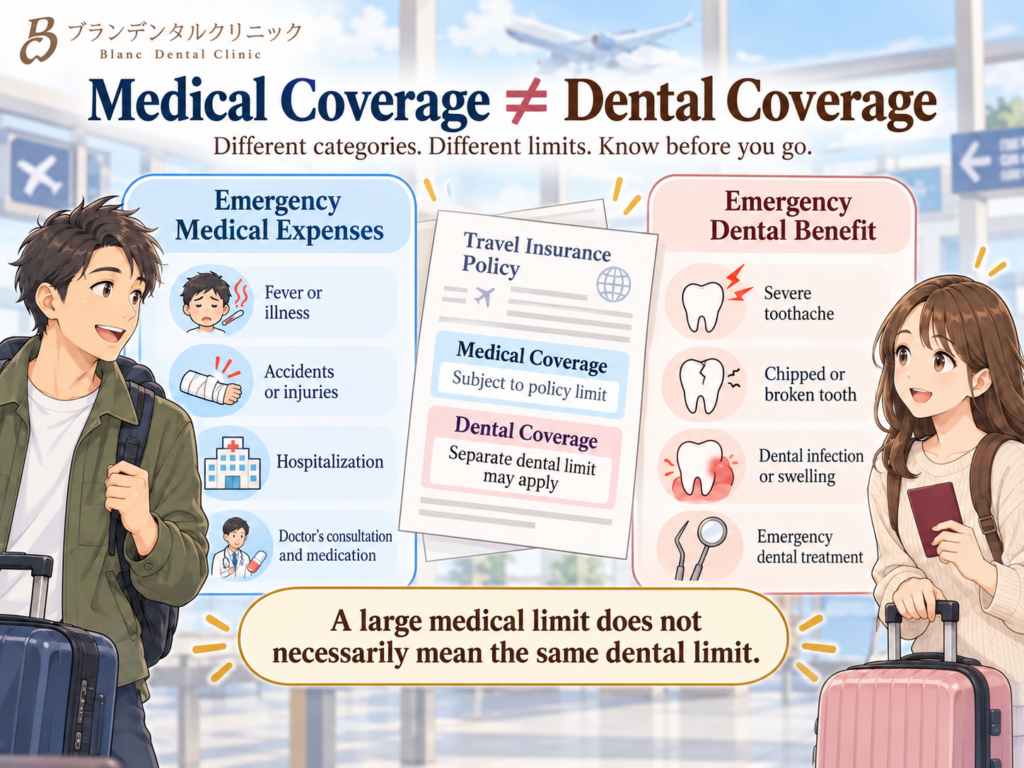
Medical Coverage Does Not Automatically Mean Dental Coverage
This is one of the easiest misunderstandings to make.
A travel-insurance policy may advertise a large emergency-medical benefit.
That does not necessarily mean that the same limit applies to dental treatment.
Dental care may have:
a separate benefit,
a separate definition,
a smaller sublimit,
a separate deductible or excess,
different exclusions,
or different direct-billing rules.
So if your policy says:
“Emergency Medical Expenses: $50,000”
do not automatically conclude:
“I have $50,000 available for dental treatment.”
Look separately for wording such as:
Emergency Dental Treatment
Emergency Dental Expense
Dental Injury
Dental Benefit
Dental Sublimit
Dental Pain Relief
If the wording is unclear, ask the insurer directly.
2. What Types of Dental Problems May Be Covered?
Sudden Toothache
Suppose your tooth felt normal when your trip began, but you suddenly develop severe pain while traveling in Japan.
Some policies may treat this as an emergency dental problem.
Published policy information from some insurers refers to treatment intended to relieve sudden or acute dental pain.[4][5]
But the insurer may still ask:
When did the pain begin?
Was the tooth already painful before the trip?
Had treatment already started?
Had another dentist already told you that the tooth required treatment?
Does the policy cover dental disease?
Does the affected tooth meet the policy’s definition of a covered tooth?
So:
“I have a toothache.”
does not by itself establish insurance coverage.
The dentist diagnoses the dental condition.
The insurer interprets the insurance policy.
Dental Infection or Abscess
A dental infection may cause:
severe pain,
swelling,
tenderness,
difficulty chewing,
or other acute symptoms.
Some insurance products include unexpected dental infection or abscess within examples of potentially covered emergency dental problems.[4][5]
Other products exclude dental diseases from ordinary travel-insurance benefits.
For example, Tokio Marine & Nichido publishes guidance indicating that dental disease is excluded from the particular overseas-travel insurance benefit discussed in its FAQ, and its cashless-service guidance also lists dental diseases among situations in which that service may not be available.[9]
This is one insurer/product example.
It is not a rule for all travel insurance.
Another policy may reach a different conclusion.
The practical point is:
Dental infection may be covered under one policy and excluded under another.
Accidental Dental Injury
Now consider a different situation.
You fall while sightseeing and fracture a front tooth.
An insurer may handle that differently from a tooth that becomes painful because of dental disease.
A policy may distinguish between:
accidental dental injury,
and emergency dental illness or pain.
For example:
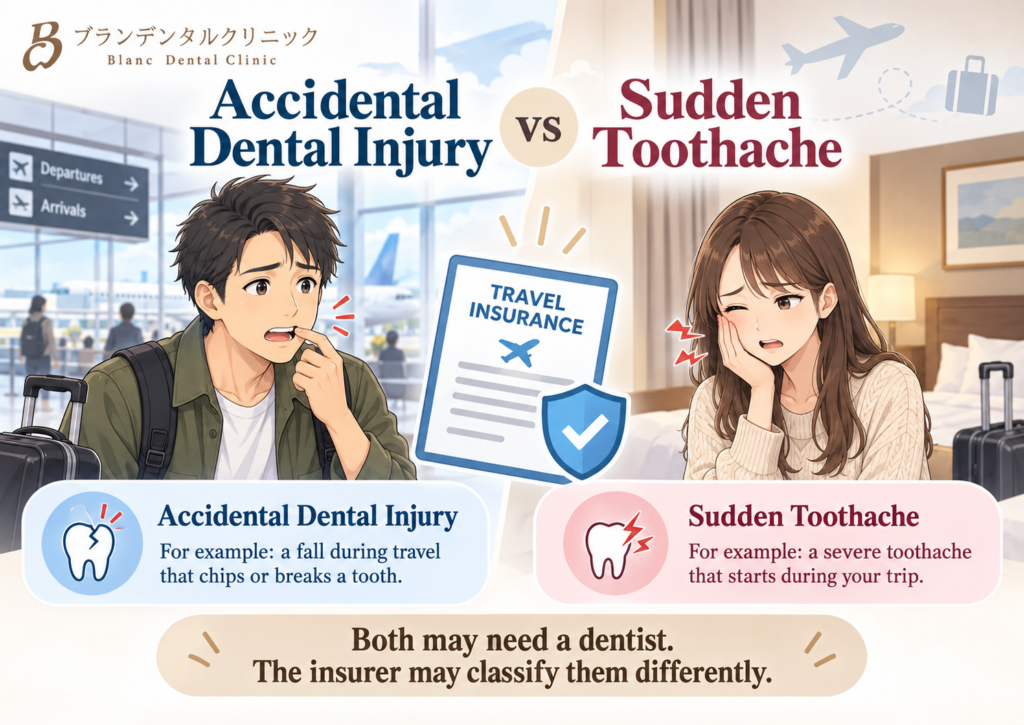
Traveler A
“I fell and broke my front tooth.”
Traveler B
“My molar suddenly started hurting last night.”
Both may need prompt dental treatment.
But the insurer may apply different sections of the policy.
That is why it is better to tell the insurer what actually happened rather than simply say:
“I need a dentist.”
If the problem followed an accident, say so.
If the pain began without an accident, say so.
If a filling or crown came out, say so.
The dental clinic should accurately document the history and findings.
It should not change the description of an event in an attempt to make an insurance claim easier to approve.
Broken or Knocked-Out Teeth
If you have actually broken or knocked out a tooth, the insurance question is only one part of the situation.
Some traumatic dental injuries are time-sensitive.
A completely knocked-out permanent tooth, for example, requires prompt dental attention.[13]
Our separate English guide,
“Broke a Tooth in Japan—Can a Dentist See Me Today?”
explains what to do after dental trauma and what information may be useful when contacting a dentist in Japan.
The important point for this article is:
Do not delay time-sensitive dental trauma for hours simply because you are still trying to understand your insurance.
Clinical urgency and insurance administration are separate issues.
Lost Fillings and Crowns
A filling or crown that comes out during a trip may cause:
acute sensitivity,
pain,
difficulty chewing,
a sharp edge,
or further damage to the tooth.
Some insurance products include situations such as a lost filling or lost crown among examples of potentially covered emergency dental problems.[4][5]
But the fact that something needs repair does not automatically mean that the entire definitive restoration is covered.
The insurer may distinguish between:
emergency stabilization,
temporary restoration,
and definitive replacement.
“Healthy Natural Teeth” Can Be an Important Insurance Term
Some travel-insurance policies use expressions such as:
healthy natural teeth
or:
sound natural teeth
Do not assume that these words simply mean:
“There is a tooth there.”
Policy definitions can be narrower.
They may take into account whether the tooth:
had previous disease,
had extensive restorative treatment,
had periodontal disease,
or had another pre-existing problem.
Definitions can even differ between products sold by the same insurance brand in different countries.
For example, World Nomads’ published dental wording differs according to country or region of residence. Some materials refer to healthy natural teeth, while Canadian information has used wording referring to natural or permanently attached artificial teeth, with separate exclusions relating to major dental work.[5][6]
This is a useful example of why travelers should not rely only on the insurance-company name.
Read the policy issued to you.
What About Crowns, Bridges, Implants, Dentures and Orthodontic Appliances?
Coverage becomes even more policy-dependent when artificial restorations or dental appliances are involved.
A policy may treat:
natural teeth,
crowns,
bridges,
implants,
removable dentures,
and orthodontic appliances
differently.
For example, Allianz’s published emergency-dental guidance describes exclusions involving dentures under the benefit it discusses.[4]
A Mitsui Sumitomo emergency-dental rider provides a very different example: it includes certain emergency repairs of dentures and orthodontic appliances when needed to temporarily relieve difficulty associated with eating.[7]
Importantly, that Mitsui Sumitomo example is from a Japanese outbound travel-insurance product for people traveling from Japan overseas.
It does not determine the coverage of insurance held by a visitor coming to Japan.
It is cited here only to demonstrate how an emergency-dental benefit can be structured.
Under that particular rider, eligible emergency-dental expenses are paid at 50% under the stated conditions rather than automatically at 100%.[7]
World Nomads’ current U.S. guidance provides another useful contrast: crowns, dentures, bridges and implants are among examples of major dental work that may fall outside the emergency-dental coverage described there.[5]
These examples demonstrate the same point:
There is no single travel-insurance rule for crowns, bridges, implants, dentures or orthodontic appliances.
What If the Tooth Already Had a Problem Before the Trip?
This is another area where a simple yes-or-no rule can be misleading.
Many insurance policies restrict or exclude pre-existing conditions.
But there is a difference between:
a cavity that existed before travel but caused no symptoms,
a tooth that was already painful before departure,
a tooth that was already undergoing treatment,
and a tooth whose symptoms suddenly worsened during the trip.
One Mitsui Sumitomo FAQ again provides a useful structural example.
Under the specific emergency-dental rider described there, a cavity that existed before departure may still fall within coverage if it suddenly worsens during travel under the rider’s conditions, while a tooth that was already painful or abnormal before departure may be excluded.[8]
Again, this is an example from a Japanese outbound travel-insurance product, not a rule for foreign visitors to Japan.
Its value is that it shows why:
“There was already a cavity.”
and:
“This was already a symptomatic dental problem before the trip.”
may not mean the same thing under an insurance contract.
“My Policy Covers Pre-Existing Medical Conditions” Does Not Automatically Mean Dental Disease Is Included
Another possible misunderstanding is:
“My travel insurance covers pre-existing medical conditions, so my dental problem must also be covered.”
Not necessarily.
Some benefits define eligible medical conditions in a way that specifically excludes dental disease.
Tokio Marine & Nichido provides one published example in which dental disease is excluded from the pre-existing-disease emergency benefit being described.[9]
So when checking a policy, ask specifically about dental conditions rather than assuming that general medical wording automatically applies.
When Did the Problem Start?
The timeline can matter greatly to an insurance claim.
Try to remember:
when the pain started,
when swelling started,
when a filling or crown came out,
when an accident happened,
what you were doing at the time,
whether the tooth had symptoms before the trip,
whether treatment had already started,
and whether another dentist had already recommended treatment.
Some insurance products require the relevant illness or injury to begin during the insured trip.
Published Allianz guidance, for example, gives an example in which a filling lost before the trip and repaired during the trip would not qualify under the emergency-dental benefit it describes.[4]
At the dental clinic, we may also ask when symptoms began because that information is clinically important.
But the clinic is not deciding how to phrase the history to maximize insurance payment.
The record should reflect what actually happened.
3. Emergency Dental Treatment Does Not Always Mean Complete Dental Treatment
“Emergency” in an Insurance Policy Is Not the Same as a Medical Emergency
The word emergency is used in two different ways.
An insurer may use:
Emergency Dental Treatment
as the name of a benefit.
That does not necessarily mean that the patient has a life-threatening condition.
A severe toothache may fit an insurance definition of emergency dental treatment without requiring an ambulance.
At the same time, some oral and facial conditions really are medically urgent.
Examples can include:
rapidly progressive facial or neck swelling,
difficulty breathing,
difficulty swallowing,
uncontrolled bleeding,
or major facial trauma.[12]
So always separate these two questions.
Insurance question
Does my policy define this as emergency dental treatment?
Clinical question
How urgently does this condition need medical or dental care?
They are not the same.
Temporary Treatment and Definitive Treatment Are Different Concepts
A traveler may think:
“The dentist says I need root-canal treatment. My policy covers emergency dental treatment. Therefore the entire root canal and final crown must be covered.”
That conclusion does not necessarily follow.
Some travel-insurance benefits focus on treatment necessary to:
relieve acute pain,
stabilize the problem,
or temporarily restore function.
Dentistry itself also distinguishes between temporary symptom management and definitive dental treatment.
The 2024 American Dental Association evidence-based guideline on acute dental pain specifically discusses temporary pharmacologic management when definitive dental treatment is not immediately available and distinguishes that temporary phase from definitive dental care.[11]
This clinical distinction does not determine insurance coverage.
The insurance contract still determines coverage.
But it helps explain why:
stabilizing an emergency
and:
completing all necessary dental treatment
are not necessarily the same thing.
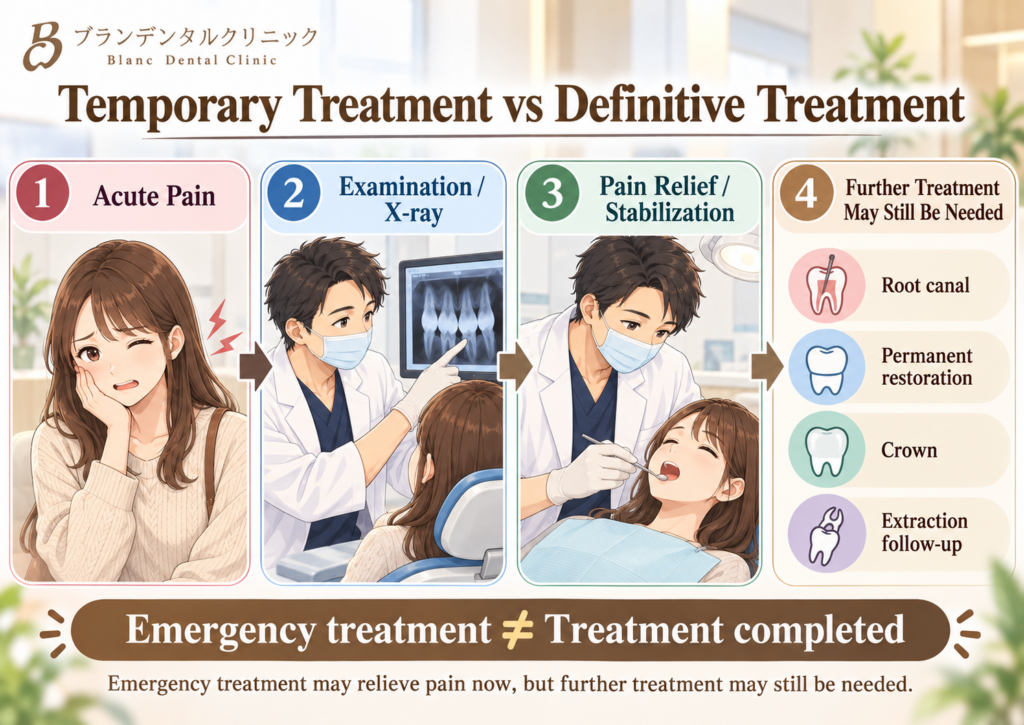
Insurance Endpoint Is Not Necessarily the Clinical Endpoint
This is one of the central ideas of this article.
Imagine that you develop severe dental pain while traveling.
The dentist examines the tooth.
An X-ray is taken.
Treatment is performed to control the immediate problem.
The pain improves.
From the perspective of an emergency-dental benefit, the insurer may consider the covered emergency treatment complete.
But clinically, the tooth may still need:
additional root-canal treatment,
a permanent filling,
a crown,
extraction follow-up,
periodontal treatment,
prosthetic treatment,
or another definitive procedure.
So:
The end of emergency insurance coverage is not necessarily the end of dental treatment.
This is why two questions should be asked separately.
Ask the dentist:
“What treatment still needs to be completed?”
Ask the insurer:
“Which parts of that treatment does my policy cover?”
Does Travel Insurance Cover Root-Canal Treatment?
There is no universal answer.
Some emergency-dental benefits are limited to acute treatment and specifically exclude or restrict root-canal treatment.
Allianz, for example, publishes guidance in which root-canal treatment is listed among treatments not covered under the particular emergency-dental benefit being described.[4]
Other policies may use different definitions.
And in some cases, treatment performed to stabilize an acute emergency may be evaluated differently from later completion of definitive care.
A better question is therefore:
“Does my policy cover this specific proposed treatment, and which part of it is authorized?”
What About Crowns and Implants After Emergency Treatment?
The same problem occurs with definitive restorative treatment.
Suppose a tooth breaks.
An emergency procedure may stabilize it.
But later the tooth may need:
a permanent crown,
a bridge,
an implant,
or another definitive replacement.
That later treatment is not automatically covered simply because it follows from the original emergency.
World Nomads’ current U.S. guidance, for example, identifies crowns, dentures, bridges and implants among major dental work not covered under the emergency-dental benefit described there.[5]
Another insurer may use different wording.
For travelers, the practical advice is simple:
If the treatment plan becomes substantially larger or more expensive, contact your insurer again when clinically appropriate.
4. How Much Will Travel Insurance Actually Pay?
Covered Does Not Mean Fully Reimbursed
Even if treatment is considered covered, you may still have out-of-pocket costs.
Possible reasons include:
a dental benefit limit,
a separate dental sublimit,
a deductible or excess,
coinsurance,
excluded procedures,
or insurer limits on eligible charges.
The Mitsui Sumitomo outbound emergency-dental rider discussed earlier provides a clear structural example: under the stated conditions of that specific rider, eligible emergency-dental expenses are paid at 50%, rather than automatically at 100%.[7]
So:
Covered does not necessarily mean fully reimbursed.
Dental Sublimits Can Be Much Smaller Than Medical Limits
A policy may advertise a large emergency-medical benefit while providing only a smaller separate dental benefit.
Published Allianz plans provide examples of this structure.[4]
Travel Guard likewise publishes products in which the medical-expense benefit and dental-expense sublimit are listed separately.[10]
The exact limits depend on the particular plan and may change over time.
The principle is what matters:
Check the dental limit itself, not only the general medical limit.
Deductible / Excess
A policy may require the traveler to pay an initial amount before the insurance benefit applies.
Depending on the country and policy wording, this may be called:
a deductible,
or an excess.
So even a covered treatment may leave the patient responsible for part of the bill.
Coinsurance
Some policies pay only a percentage of the eligible expense.
For example:
insurer pays a specified percentage,
patient pays the remaining percentage.
Again:
Covered does not mean every yen will necessarily be reimbursed.
“Reasonable” or “Usual and Customary” Charges
Some insurance contracts also limit reimbursement to charges that meet the insurer’s definition of reasonable, customary or otherwise eligible expenses.
That means:
Dental clinic bill = amount actually charged
does not always equal:
Insurance reimbursement = amount ultimately paid by the insurer
The dental clinic can document the actual charge.
The insurer decides how the contract applies to that charge.
Primary and Secondary Coverage
Some travelers also have medical or dental insurance in their home country.
Travel insurance can sometimes operate as:
primary coverage,
or secondary coverage.
With secondary coverage, another applicable health or dental plan may need to be considered before the travel insurer determines its final payment.
This is a more advanced insurance issue, but it is worth checking if you have multiple forms of coverage.
Three Words Travelers Should Not Confuse
There is also a fourth concept:
Fully Reimbursed
A treatment can be covered without being reimbursed at 100%.
There may be:
a dental limit,
a deductible,
an excess,
coinsurance,
excluded treatment,
or another policy restriction.
So:
Covered ≠ Cashless ≠ Fully Reimbursed
5. Cashless Payment, Direct Billing and Guarantee of Payment
“Cashless” Can Mean Two Completely Different Things
This is particularly important in Japan.
At a dental clinic, cashless payment may simply mean that the patient can pay with:
a credit card,
electronic money,
transportation IC payment,
or another non-cash payment method.
The patient is still paying the dental clinic.
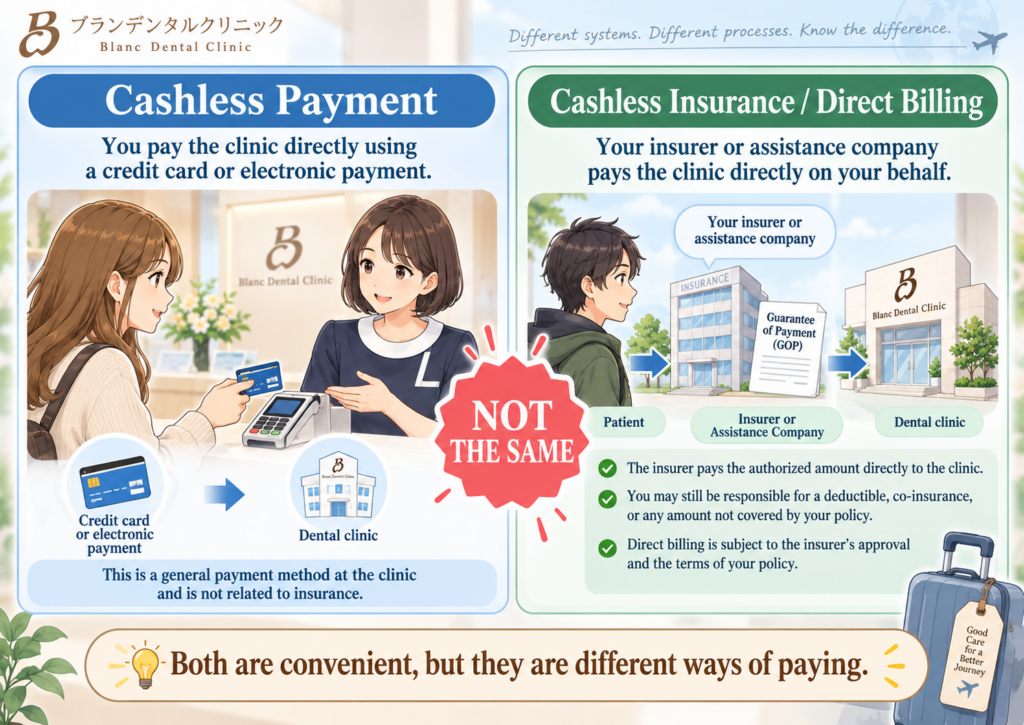
That is different from cashless insurance or direct billing.
With direct billing, an insurer or assistance company may arrange to pay an authorized amount directly to the medical institution.
So:
Cashless payment ≠ Cashless insurance
At the reception desk, this distinction can prevent a surprising misunderstanding.
A patient may ask:
“Do you accept cashless payment?”
The receptionist may think:
“Do we accept credit cards?”
But the patient may actually mean:
“Will my travel insurer pay the clinic directly?”
A useful clarification is:
“Do you mean paying by credit card, or direct billing through your travel insurer?”
“My Insurance Has Cashless Service. Why Do I Still Have to Pay the Dentist?”
This can happen.
Detailed Ministry of Health, Labour and Welfare guidance for medical institutions explains that some overseas travel-insurance arrangements may provide cashless service for ordinary medical care while excluding dental treatment from that cashless system.[2]
In such a case:
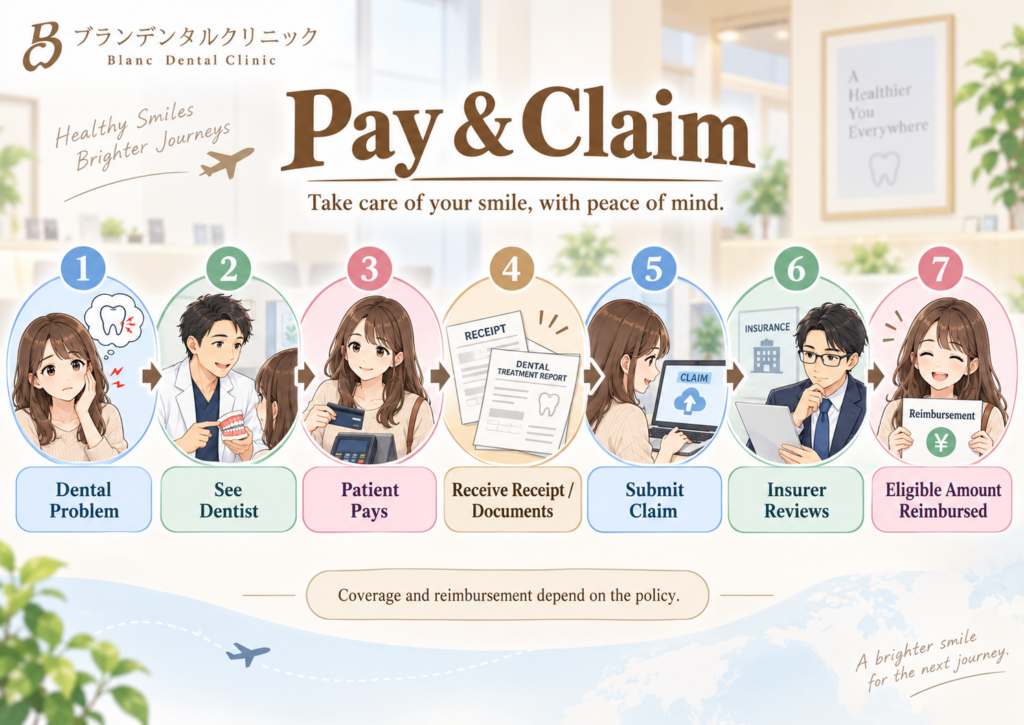
Patient ↓ receives dental treatment ↓ pays the dental clinic ↓ obtains the required documents ↓ submits a claim ↓ the insurer evaluates reimbursement.
This is a pay-and-claim arrangement.
Therefore, do not ask only:
“Does my policy have cashless medical service?”
Ask:
“Is dental treatment in Japan eligible for cashless/direct billing under my policy?”
What Is Pay-and-Claim?
Pay-and-claim is straightforward.
You receive dental treatment.
You pay the clinic.
You obtain the necessary documents.
You submit a claim to the insurer.
The insurer evaluates the claim.
The insurer reimburses the eligible amount according to the contract.
The important phrase is:
eligible amount
The clinic documents what was done and what was paid.
The insurer decides what is reimbursable.
What Is Direct Billing?
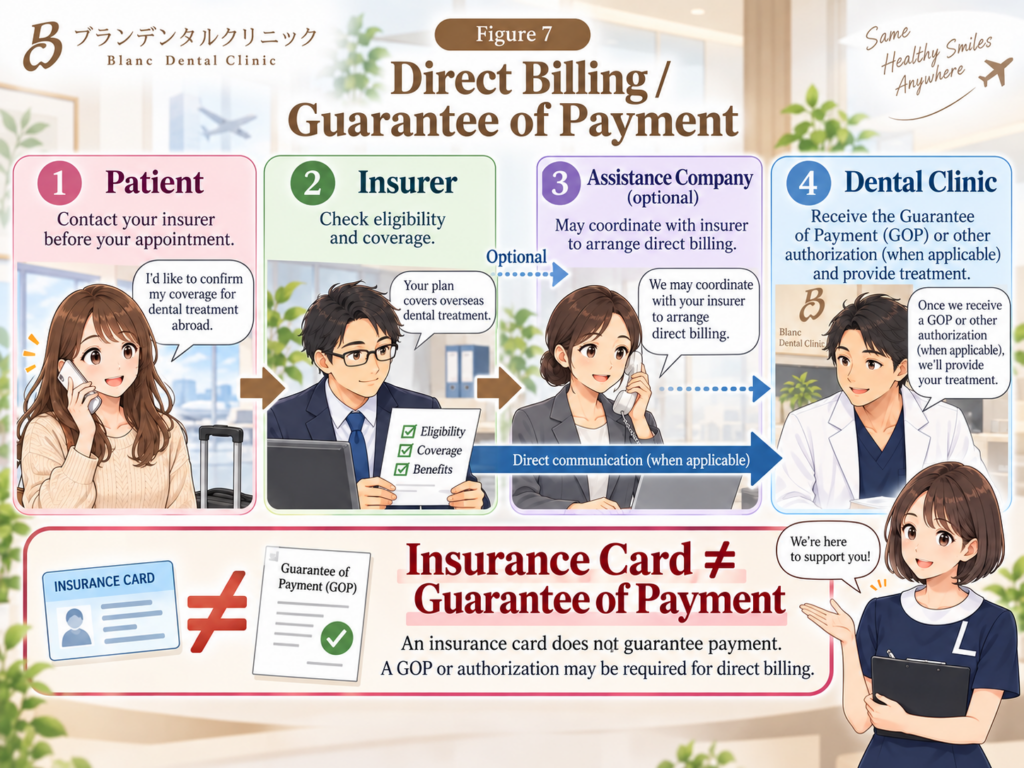
Direct billing means the insurer or assistance company arranges payment directly with the medical institution for an authorized amount.
The exact process varies.
Japanese Ministry of Health, Labour and Welfare materials describe a general model in which:
Patient ↓ contacts insurer or designated call center ↓ insurance eligibility and coverage are checked ↓ an assistance company may coordinate with the medical institution ↓ payment authorization is communicated.[1][2]
Simply presenting an insurance card does not automatically complete this process.
What Is a Guarantee of Payment?
You may hear the term:
Guarantee of Payment
or:
GOP
A GOP is used in some international-insurance and assistance arrangements to communicate a payment guarantee to a medical institution.
Depending on the insurer and the document, a GOP may state information such as:
the insured person,
insurance eligibility,
authorized treatment or scope,
authorized period,
financial limit,
or other payment conditions.[2]
The exact format varies.
That leads to an important rule:
Insurance card ≠ Guarantee of Payment.
An insurance card may show that you have a policy.
It does not necessarily tell the dental clinic that the insurer guarantees payment for the treatment being performed today.
Cashless Does Not Mean Unlimited
Even when direct billing has been arranged, the insurer does not necessarily guarantee every charge.
Ministry of Health, Labour and Welfare guidance explains that a payment guarantee applies only within the scope of the guarantee, and expenses outside that scope or above the stated limit may remain the patient’s responsibility.[2]
So:
Cashless does not mean unlimited.
If direct billing is being arranged, useful questions include:
What treatment has been authorized?
Up to what amount?
Is there a deductible?
Are there excluded items?
What happens if the treatment plan changes?
Who pays any amount above the authorization?
6. What Should You Do Before Seeing a Dentist?
Contact Your Insurer When Possible
If the situation is not time-sensitive, contacting your insurer before treatment can make the financial process easier.
The current Ministry of Health, Labour and Welfare guidance for medical institutions receiving foreign patients instructs reception staff, when a patient wishes to use overseas travel insurance, to have the patient contact the insurer.[1]
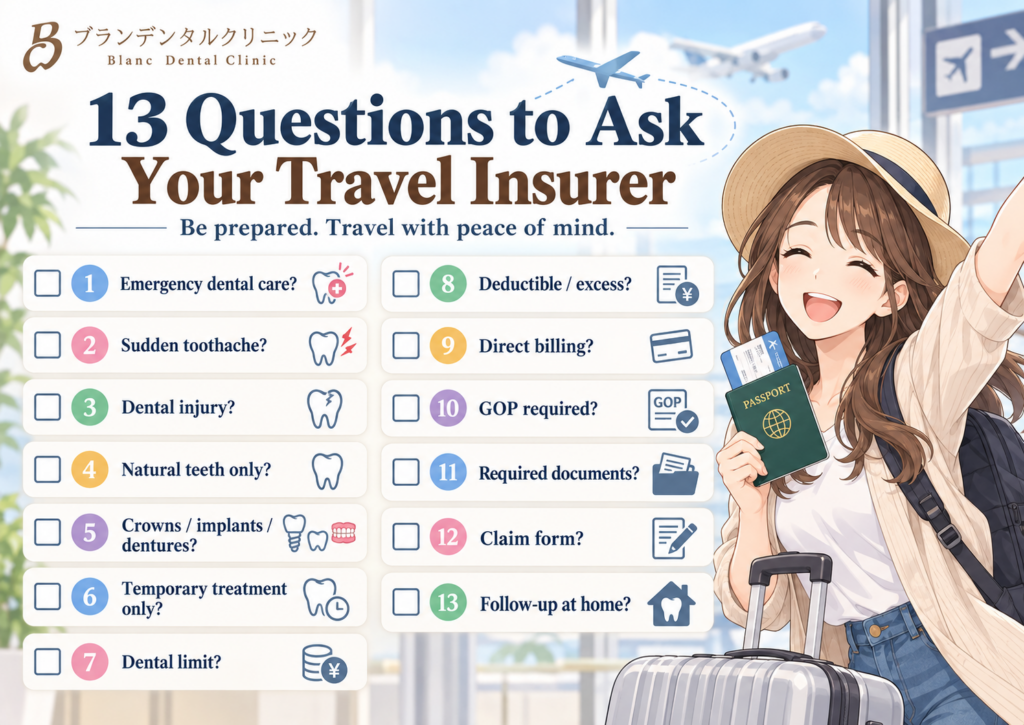
A useful list of questions is:
Does my policy cover emergency dental treatment in Japan?
Does it cover sudden toothache?
Does it cover accidental dental injury?
Does coverage apply only to natural teeth?
How are crowns, bridges, implants, dentures or orthodontic appliances handled?
Is treatment limited to emergency pain relief or temporary treatment?
What is my dental benefit limit?
Is there a deductible, excess or coinsurance?
Is dental treatment eligible for direct billing?
Do you need to send a Guarantee of Payment?
What documents do you require from the dentist?
Do you have your own claim form?
Is follow-up treatment after I return home covered?
You do not need to understand every insurance term before seeing a dentist.
But these answers can prevent confusion later.
What Should You Tell the Dental Clinic?
You do not need to diagnose yourself.
Tell the reception desk what actually happened.
For example:
“My tooth started hurting last night.”
“I fell and broke my front tooth this morning.”
“My filling came out while I was eating.”
“My gum has become swollen.”
“I have travel insurance.”
“I already contacted my insurer.”
“My insurer gave me a claim number.”
“My insurer says direct billing may be available.”
“I am leaving Japan in three days.”
That information is much more useful than trying to guess the diagnosis.
What Should You Bring?
If available, bring:
a passport or other identification,
travel-insurance card or policy information,
insurer contact information,
policy number,
claim or authorization number,
insurer claim form if one exists,
medication information,
allergy information,
and information about previous treatment on the affected tooth.
If you already have relevant dental X-rays or treatment information that can be easily accessed, those may also be useful.
But do not delay truly urgent care simply because one document is missing.
“My Insurance Limit Is $500. Can You Keep the Treatment Under $500?”
This is understandable.
Travelers may know that their dental benefit has a relatively low limit.
The clinic may be able to explain fees or provide an approximate cost once the likely treatment becomes clearer.
But:
insurance limit
and:
clinically necessary treatment
are different concepts.
The diagnosis should not be changed to fit the insurance policy.
The dentist explains:
the dental condition,
urgency,
treatment options,
and possible consequences of delaying treatment.
The clinic can explain known costs.
The patient then decides how to proceed after considering:
the dental condition,
available options,
travel schedule,
personal circumstances,
and insurance coverage.
Estimate Before Treatment and Final Bill After Treatment Are Different
An insurer may ask for an estimate before a substantial treatment.
Later, it may ask for a receipt and itemized statement after treatment.
Those are different documents.
An estimated cost does not prove what was ultimately performed.
And a final receipt does not necessarily show what had been planned beforehand.
If your insurer needs prior approval or an estimate, ask before treatment becomes more extensive when clinically possible.
If the Treatment Plan Changes, Contact the Insurer Again
Imagine that everyone initially expects a small temporary repair.
After examination, however, the dentist finds that the tooth needs:
root-canal treatment,
drainage,
extraction,
or another more extensive procedure.
Do not assume that an earlier conversation with the insurer automatically authorizes everything that follows.
If the situation is clinically safe enough to allow another call, ask:
“Has this specific treatment been authorized?”
and:
“Up to what amount?”
7. What Documents Should You Keep for Your Insurance Claim?
Ask the Insurer What It Actually Needs
There is no universal document package.
Depending on the insurer, you may be asked for:
a receipt,
itemized statement,
proof of payment,
dental report,
diagnosis,
treatment description,
date symptoms began,
accident details,
prescription,
pharmacy receipt,
clinical records,
X-rays,
or an insurer-specific claim form.
World Nomads, for example, advises travelers under certain policies to retain relevant dental records and receipts and may require written confirmation relating to the dental illness or injury and treatment.[5]
So ask:
“Exactly which documents do you require from the dental clinic?”
That is much more useful than telling the receptionist:
“I need an insurance paper.”
Receipt, Itemized Statement and Dental Report Are Different
A receipt mainly proves that payment was made.
An itemized statement explains the breakdown of charges.
A dental report or certificate may contain clinical information such as:
diagnosis,
symptoms,
findings,
and treatment.
A claim form may be a form created by the insurer and may require the dentist to complete specific fields.
These documents are not interchangeable.
If your insurer has its own claim form, show it to the clinic as early as possible.
Keep the Pharmacy Receipt Too
Dental care in Japan may sometimes involve medication dispensed at a separate pharmacy.
That creates two different payments:
Dental clinic payment and pharmacy payment.
If prescription medication may be part of the claim, keep the pharmacy receipt and related documents.
Do not assume the dental-clinic receipt includes medication purchased elsewhere.
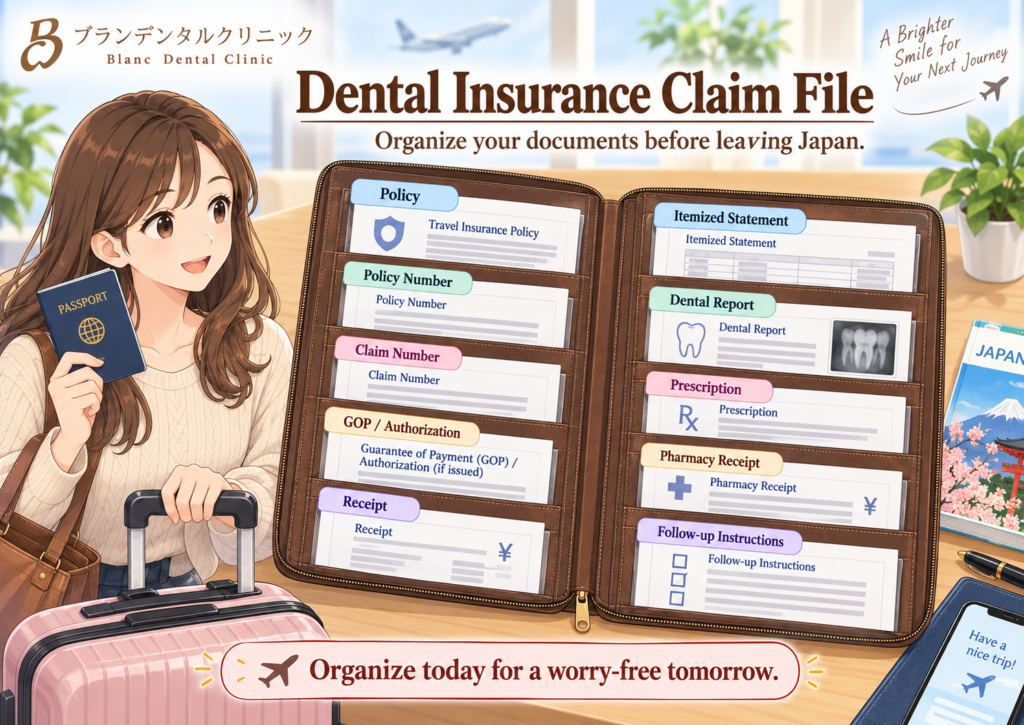
Create a Small “Dental Insurance Claim File”
Before leaving Japan, it can be useful to keep all relevant information together.
Insurance information
insurance card
policy details
policy number
claim number
insurer emails
assistance-company correspondence
authorization or GOP information
Dental documents
receipt
itemized statement
dental report
relevant treatment information
Medication
prescription
pharmacy receipt
Follow-up information
what treatment was performed
what treatment remains
instructions for the next dentist
Keep these documents until the claim has been fully settled.
What If You Lose the Receipt?
Contact the clinic.
At Blanc Dental Clinic, if a receipt is lost, we can reissue the receipt and clearly indicate that it is a reissued document.
However:
Whether the insurer accepts a reissued receipt is decided by the insurer.
The dental clinic cannot guarantee that a reissued document will satisfy another organization’s rules.
We explain the distinction between reissued receipts, itemized statements and other payment documents in our separate article:
“領収書をなくした!歯医者で再発行できる?『再発行』表記と領収証明書との違い”
What If the Insurer Requires an English Report?
Ask the clinic as early as possible.
Some insurers may accept ordinary clinic documentation.
Others may require:
an English certificate,
detailed treatment information,
a form with specific fields,
or a document signed by the dentist.
Document type, preparation time and possible fees can differ.
If you are leaving Japan soon, do not wait until immediately before departure to show the clinic a complicated insurance form if you can avoid it.
8. What If You Are Leaving Japan Soon?
Tell the Dentist Your Departure Date
Your departure date does not change the diagnosis.
But it can affect practical treatment planning.
There is a major difference between:
“I leave Japan tomorrow.”
and:
“I will be here for another month.”
Depending on the diagnosis, treatment may involve:
complete treatment in Japan,
emergency stabilization only,
temporary restoration,
medication and monitoring,
or transfer of care to your dentist after returning home.
Tell the clinic when you are leaving Japan.
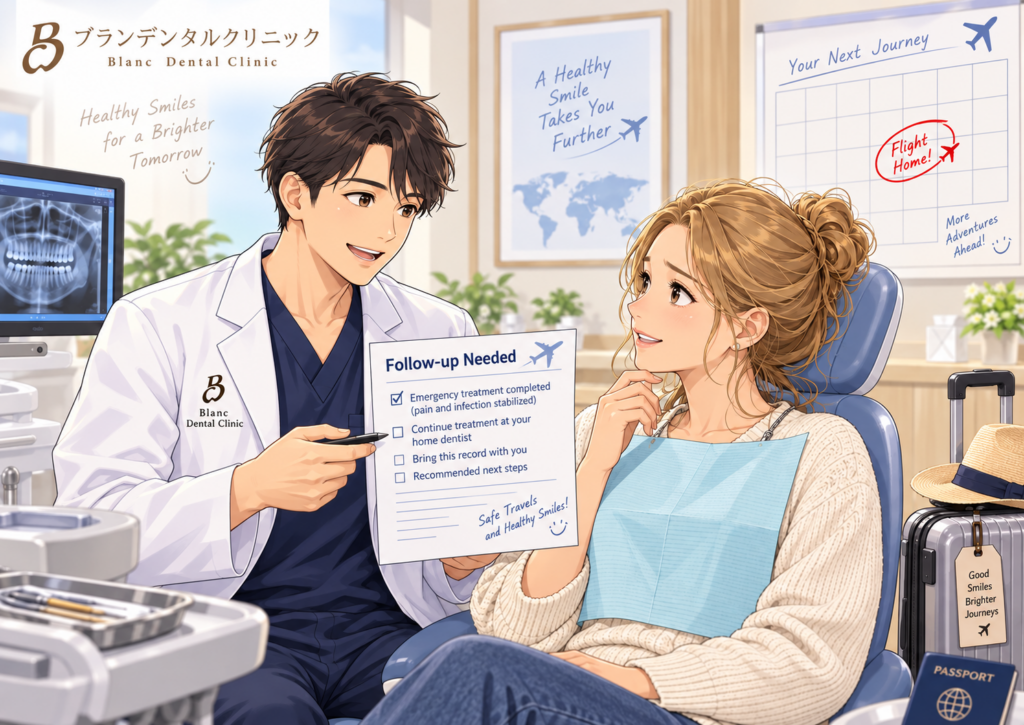
Ask What Treatment Still Needs to Be Done
Before leaving, ask:
“Is my treatment complete?”
and, if not:
“What should my dentist at home do next?”
This is different from asking:
“Has my travel insurance finished paying?”
Remember:
Insurance endpoint ≠ clinical endpoint.
Is Follow-Up Treatment After Returning Home Covered?
Do not assume so.
Some travel-insurance dental benefits apply only to expenses incurred during the insured trip.
For example, current World Nomads U.S. guidance states that dental expenses incurred after returning home are not covered under the emergency-dental benefit it describes.[5]
Other products may work differently.
Therefore ask:
“Does my policy cover follow-up dental treatment after I return home?”
The insurer answers that question.
Separately ask the dentist:
“What follow-up treatment do I clinically need?”
Can I Buy Travel Insurance After Arriving in Japan?
Japan National Tourism Organization guidance explains that some private medical-insurance products can be purchased after arrival in Japan.[3]
But this creates an important distinction:
Buying insurance after arriving in Japan
and:
Buying insurance after the dental problem has already started
are not the same thing.
A newly purchased policy does not automatically cover a problem that already exists.
Some insurer guidance specifically gives dental pain beginning before policy purchase as an example of a non-covered situation.[6]
Check:
policy start date,
waiting periods,
pre-existing-condition provisions,
and dental exclusions.
What About Travel Insurance Through a Credit Card?
Some travelers rely on travel insurance included with a credit card.
Do not assume:
“My card includes travel insurance.”
means:
“My card insurance covers dental treatment.”
Check:
whether dental treatment is included,
what the dental limit is,
whether conditions apply before coverage becomes active,
whether treatment is direct billing or reimbursement,
and what documents are needed.
The same principles apply.
Do Not Delay Urgent Care Solely for Insurance Paperwork
Insurance arrangements matter.
But there are situations in which clinical urgency takes priority.
Seek appropriate care promptly if you have symptoms such as:
rapidly increasing facial or neck swelling,
difficulty breathing,
difficulty swallowing,
uncontrolled bleeding,
major facial trauma,
or a completely knocked-out permanent tooth.[12][13]
Some problems belong primarily at a dental clinic.
Others may require emergency medical care.
In Japan, the emergency ambulance number is 119.[3]
The important principle is:
Clinical urgency comes before administrative convenience.
Insurance arrangements can be addressed once urgent care is underway.
9. What Can the Dentist, Insurer, Patient and Reception Desk Each Decide?
The Dentist
The dentist determines:
the diagnosis,
the clinical findings,
how urgent the problem is,
what treatment is appropriate,
whether temporary care is appropriate,
and what definitive treatment may still be needed.
The Insurer
The insurer determines:
whether the event meets the policy conditions,
whether dental treatment is covered,
which expenses are eligible,
the applicable limit,
deductible or coinsurance,
whether direct billing is available,
and the final reimbursement.
The Patient
The patient decides how to proceed after hearing:
the diagnosis,
treatment options,
urgency,
cost,
travel schedule,
and insurance information.
The Reception Desk
The reception desk can help with:
appointment arrangements,
confirming what happened,
asking whether an insurer has been contacted,
explaining the clinic’s payment process,
confirming whether an insurer or assistance company has contacted the clinic,
explaining available clinic documents,
issuing receipts and related documents,
and passing important travel or insurance information to the clinical team.
But the reception desk cannot:
diagnose the tooth,
promise that a procedure is covered,
guarantee reimbursement,
interpret every international insurance contract,
or decide the insurer’s final claim.
A simple way to remember the division is:
The dentist treats the dental problem. The insurer decides the claim. The reception desk helps connect the practical steps.
A Simple Example: Sudden Toothache in Japan
A traveler develops severe molar pain while staying in Hiroshima.
The traveler calls the insurer.
The insurer confirms that the policy has a limited emergency-dental benefit for sudden pain.
However, dental treatment is not eligible for direct billing.
The traveler calls a dental clinic.
The dentist performs an examination and takes an X-ray.
Emergency treatment is provided to stabilize the immediate problem.
The traveler pays the clinic.
The clinic issues a receipt and other available documentation.
The traveler submits those documents to the insurer.
The insurer then decides:
whether the claim meets the policy,
which expenses are eligible,
and how much will be reimbursed.
This is one example of a pay-and-claim process.
Your policy may work differently.
Another Example: A Tooth Breaks in an Accident
A traveler falls while sightseeing and fractures a front tooth.
The first issue is the dental injury itself.
The traveler contacts a dental clinic quickly.
The traveler also contacts the insurer when practical and explains:
when the accident occurred,
what happened,
and which tooth was injured.
The dental clinic documents:
the findings,
diagnosis,
treatment,
and charges.
The insurer applies the insurance policy.
Again:
Clinical necessity and insurance coverage are separate decisions.
Frequently Asked Questions
Does travel insurance cover a toothache in Japan?
Sometimes.
Some policies cover emergency treatment for sudden dental pain, while others exclude dental disease or apply narrower conditions.
Check the dental section of your own policy.
Does travel insurance cover a broken tooth?
It may.
Accidental dental injury is included in some policies, but limits and exclusions vary.
If the tooth was damaged in an accident, tell the insurer how and when the accident happened.
Does travel insurance cover a dental infection?
Some policies may cover emergency treatment for an unexpected infection.
Other products may exclude dental disease.
The answer depends on the contract.
Does travel insurance cover root-canal treatment?
Not automatically.
Some emergency-dental benefits focus on immediate relief or temporary treatment and may exclude or limit definitive root-canal treatment.
Ask about the specific proposed procedure.
Are crowns, bridges and implants covered?
Possibly, depending on the policy.
Natural teeth and artificial restorations may be treated differently.
Some policies specifically exclude major restorative treatment, while another policy may use different wording.
Read your own policy.
Are dentures covered?
Not always.
Some policies exclude denture damage.
Some specific dental riders may provide limited emergency repair.
Does travel insurance make dental treatment cashless?
Not necessarily.
Some policies provide cashless service for ordinary medical care but require dental patients to pay first and claim later.[2]
Is my travel-insurance card enough for direct billing?
Not necessarily.
The insurer or assistance company may need to confirm the case and may issue a Guarantee of Payment or another form of authorization.
Does “covered” mean I will get all of my money back?
No.
There may be:
a separate dental limit,
deductible,
excess,
coinsurance,
or excluded expenses.
Who decides whether the insurance claim will be paid?
The insurer.
The dentist documents the diagnosis, treatment and charges.
The clinic cannot guarantee claim approval.
What documents should I get from the dentist?
Ask the insurer.
Common possibilities include:
a receipt,
itemized statement,
dental report,
treatment details,
or an insurer-specific claim form.
What if I lose my receipt?
Contact the clinic.
At Blanc Dental Clinic, a receipt can be reissued with a reissue notation.
Whether your insurer accepts that document is decided by the insurer.
Can I buy insurance after I arrive in Japan?
Some products can be purchased after arrival.
That does not mean that a dental problem that has already started is automatically covered.
Should I wait for insurance approval if my face is becoming severely swollen?
Do not delay potentially urgent dental or medical care solely for insurance paperwork.
Seek appropriate care.
For International Patients Visiting Blanc Dental Clinic in Hiroshima
If you are visiting Hiroshima and develop a dental problem, you do not need to know the exact diagnosis before contacting us.
Tell our reception staff what happened and what symptoms you have.
For example:
“My tooth has been hurting since last night.”
“My filling came out today.”
“I broke my tooth this morning.”
“My gum is swollen.”
“I have travel insurance.”
“I already contacted my insurer.”
“I am leaving Japan on Friday.”
If your insurer has given you:
a claim number,
authorization number,
GOP,
assistance-company contact,
or its own claim form,
please tell us or show the document when appropriate.
For ordinary appointments, WEB, LINE and telephone booking are available.
For acute pain, swelling or a recent dental injury when you hope to be seen the same day, telephone contact can be particularly useful because the reception desk can ask what happened and check the appointment situation.
If your insurance uses pay-and-claim, remember that you may need to pay the clinic first.
Paying by credit card or another cashless payment method at the clinic is not the same thing as insurance direct billing.
Summary
Travel insurance may cover dental care received in Japan.
But the important details are in the policy wording.
Dental coverage may be separate from ordinary medical coverage.
Sudden toothache and accidental dental injury may be treated differently.
Natural teeth, crowns, bridges, implants, dentures and orthodontic appliances may not all be treated the same way.
Emergency dental treatment may cover only pain relief or temporary stabilization rather than completion of definitive treatment.
Dental benefits may also have:
a separate limit,
deductible,
excess,
coinsurance,
or direct-billing restrictions.
Before treatment, when clinically possible, confirm:
What dental treatment is covered?
What is the dental limit?
Do I pay first or is direct billing available?
Is a GOP required?
What documents do I need?
Will follow-up treatment after I return home be covered?
And remember these four distinctions:
Cashless payment ≠ cashless insurance.
Insurance card ≠ Guarantee of Payment.
Covered ≠ cashless ≠ fully reimbursed.
The end of emergency insurance coverage is not necessarily the end of dental treatment.
The dentist determines what care you clinically need.
The insurer determines what the policy will pay.
The reception desk helps connect the practical steps between them.
And if the dental or medical condition is genuinely urgent, do not delay necessary care solely because the insurance paperwork is not yet complete.
References
Japanese Government and Official Visitor Guidance
1. Ministry of Health, Labour and Welfare, Japan
受付で使える訪日外国人受診者対応簡易手順書 / 訪日外国人の受診時対応チェックリスト. Version 1.2, partially revised October 9, 2025.
Current practical guidance for reception staff handling foreign patients, including the recommendation that a patient wishing to use overseas travel insurance should contact the insurer.
2. Ministry of Health, Labour and Welfare, Japan
外国人患者の受入れのための医療機関向けマニュアル and related detailed guidance concerning overseas travel insurance.
Used in this article for detailed explanations of cashless medical services, assistance companies, Guarantee of Payment, authorized payment limits, and the fact that some overseas travel-insurance arrangements may exclude dental treatment from cashless service even when ordinary medical care is cashless.
3. Japan National Tourism Organization / Japan Travel
Travel Insurance in Japan / For Safe Travels in Japan.
Visitor guidance concerning travel insurance in Japan, including insurance that may be available after arrival, credit-card travel insurance, cashless arrangements, emergency contact information and Japan’s emergency number.
Travel-Insurance Policy Examples
The insurer materials below are cited only to demonstrate how dental definitions, exclusions and benefits can differ between policies. Blanc Dental Clinic does not recommend, rank or endorse these insurance products. The policy wording issued to the individual traveler takes priority.
4. Allianz Partners / Allianz Travel Insurance
Does Travel Insurance Cover Dental Emergencies?
Examples involving emergency dental injury, infection, lost crowns, broken teeth, dental limits, primary/secondary coverage and exclusions including non-emergency treatment under the benefit described.
5. World Nomads
Travel Insurance for Dental Emergencies / Overseas Dental — United States and general policy information.
Examples involving sudden dental pain, emergency dental treatment, claim documentation, major dental work and dental expenses incurred after returning home.
6. World Nomads Canada and other country-specific guidance
Country-specific emergency-dental guidance.
Used to demonstrate that wording relating to natural teeth, permanently attached artificial teeth, pre-existing problems and policy-purchase timing can vary by country or region of residence.
7. Mitsui Sumitomo Insurance
海外旅行保険 緊急歯科治療費用補償特約.
A Japanese outbound travel-insurance example.
Used only to demonstrate how an emergency-dental rider can define temporary relief of dental symptoms, emergency repair of dentures or orthodontic appliances, and partial reimbursement of eligible dental expenses.
It does not determine coverage for foreign visitors traveling to Japan.
8. Mitsui Sumitomo Insurance FAQ
Guidance concerning a cavity or other dental problem that existed before departure and then suddenly worsened during travel under the specific emergency-dental rider.
Again, this is cited as an example of policy structure, not as a rule applying to international visitors to Japan.
9. Tokio Marine & Nichido Fire Insurance
Overseas-travel insurance FAQ and cashless-service guidance.
Example of policy wording in which dental disease is excluded from certain benefits and may be outside the cashless-service arrangement described.
10. Travel Guard
Current published travel-insurance plan comparison information.
Used as an example showing that a general medical-expense benefit and a separate dental-expense sublimit may be listed independently.
Dental Clinical and Emergency Guidance
11. Carrasco-Labra A, Polk DE, Urquhart O, et al.
Evidence-based clinical practice guideline for the pharmacologic management of acute dental pain in adolescents, adults, and older adults.
Journal of the American Dental Association. 2024;155(2):102–117.e9. doi:10.1016/j.adaj.2023.10.009.
Used in this article to distinguish temporary management of acute toothache from definitive dental treatment.
This clinical distinction is separate from insurance coverage.
12. NHS
Dental abscess.
Used for emergency warning signs including severe swelling and difficulty breathing or swallowing.
13. American Dental Association / MouthHealthy
Dental Emergencies.
Used for general emergency guidance relating to traumatic dental injury, including completely knocked-out permanent teeth.
Related Blanc Dental Clinic Articles
14. Blanc Dental Clinic
I Have National Health Insurance. Why Do I Have to Pay the Full Cost of My Dental Treatment? | Self-Pay Treatment and Japan’s High-Cost Medical Expense Benefit.
15. Blanc Dental Clinic
Broke a Tooth in Japan—Can a Dentist See Me Today?
16. Blanc Dental Clinic
歯医者の支払い方法は何が使える?現金・クレジットカード・電子マネー・バーコード決済のご案内.
17. Blanc Dental Clinic
領収書をなくした!歯医者で再発行できる?「再発行」表記と領収証明書との違い.
Important Note
Travel-insurance coverage differs by insurer, policy, country or region of residence, plan, purchase date and individual contract.
The insurance-company materials cited above are examples used to explain why policy wording matters.
They are not a comparison, ranking or recommendation of insurance products.
This article provides general information for international patients considering dental care in Japan.
It does not guarantee insurance coverage, direct billing or reimbursement for any individual patient or treatment.
The current policy wording and the insurer’s final claim decision take priority.