2026年9月18日
(受付さんの備忘録)
Introduction
Receptionist’s Notes | To International Patients
“I made a dental appointment while traveling in Japan. Do I need to bring my passport?”
“I live in Japan and have a Residence Card. Is that enough when I go to the dentist?”
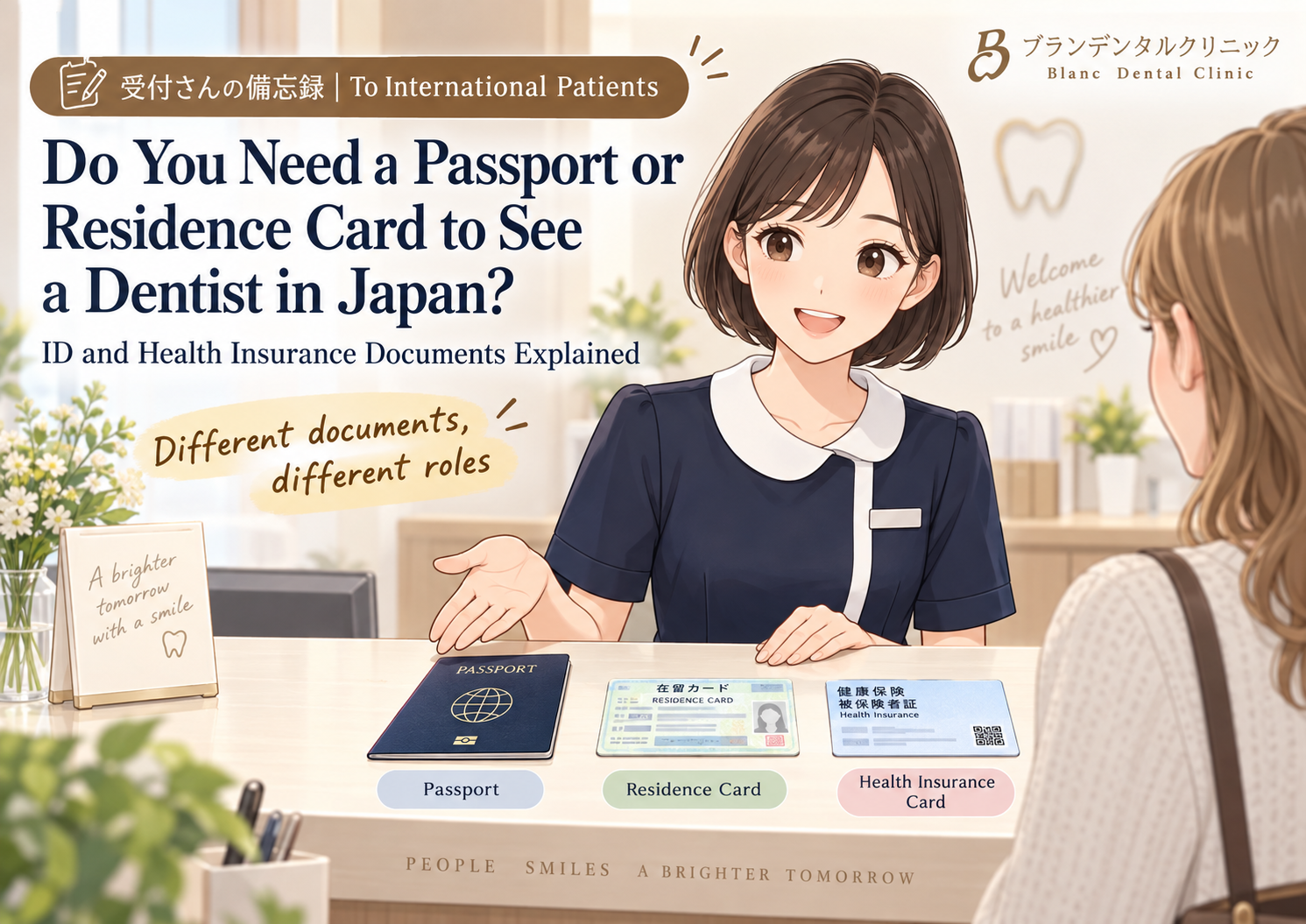
These sound like simple questions, but the answer can become confusing because several different cards and documents may be involved at a dental reception desk in Japan.
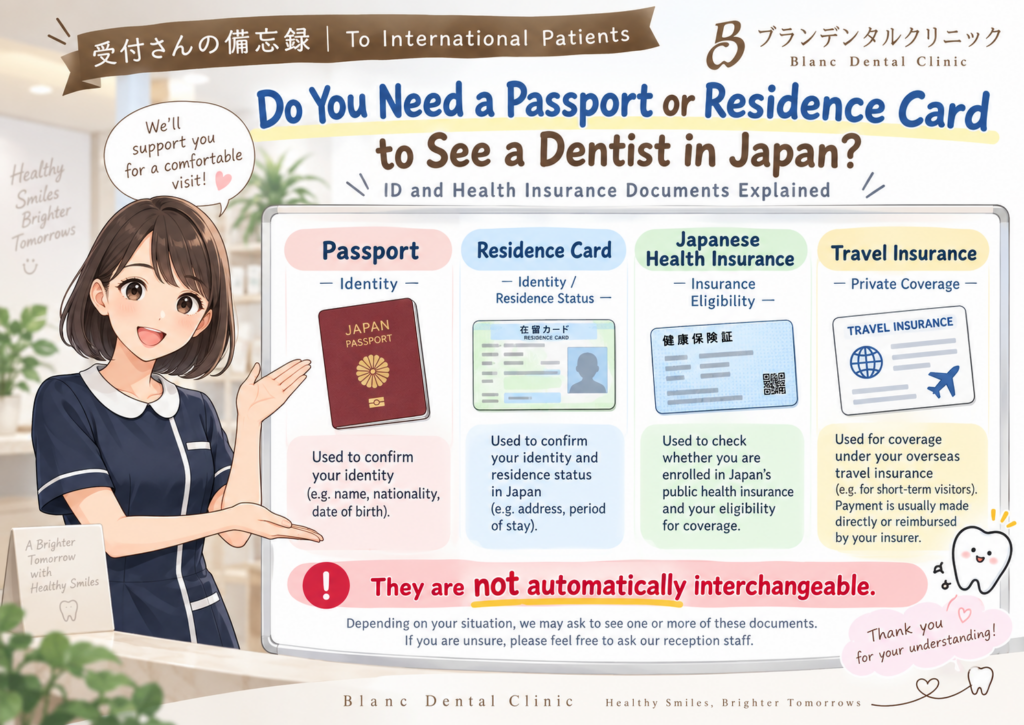
A passport, Residence Card, Myna Health Insurance Card, Health Insurance Eligibility Certificate, and travel insurance document do not all serve the same purpose.
- Passport or Residence Card: mainly helps confirm who you are.
- Japanese health insurance documents: help confirm whether you currently have Japanese public health insurance eligibility.
- Travel insurance: provides information about a separate private insurance policy.
In other words, showing a Residence Card does not automatically mean that your Japanese health insurance has been confirmed.
There is also an important change in 2026. Since June 14, 2026, Japan has introduced the Specified Residence Card, a type of Residence Card to which My Number Card functions can be added.
This means that some residents may now have one physical card that performs functions an ordinary Residence Card does not.
The key is not simply to ask, “Which card do I need?” It is more useful to understand what the dental clinic needs to confirm.
Do I Need a Passport or Residence Card to See a Dentist in Japan?
There is no simple nationwide rule that every foreign patient must show a passport at every dental clinic in Japan.
However, a medical or dental clinic may need to confirm a patient’s identity, and the document used for that purpose depends on the situation.
For visitors from overseas who are not enrolled in Japanese public health insurance, the Ministry of Health, Labour and Welfare provides medical institutions with guidance aimed at preventing unpaid medical bills. Under that guidance, passport-based identity confirmation is one of the reception procedures used for these overseas visitors.
For someone who lives in Japan, a Residence Card may instead be relevant as a form of identification.
But there is another question that may need to be answered:
Are you using Japanese public health insurance?
That is not the same as asking:
Who are you?
A dental clinic may therefore need to deal with two different kinds of confirmation.
Identity confirmation
Who is the patient?
Health insurance eligibility confirmation
Does this patient currently have valid Japanese public health insurance eligibility?
A passport or Residence Card may help with the first question.
A Myna Health Insurance Card, Health Insurance Eligibility Certificate, or another officially accepted qualification-verification method is used for the second.
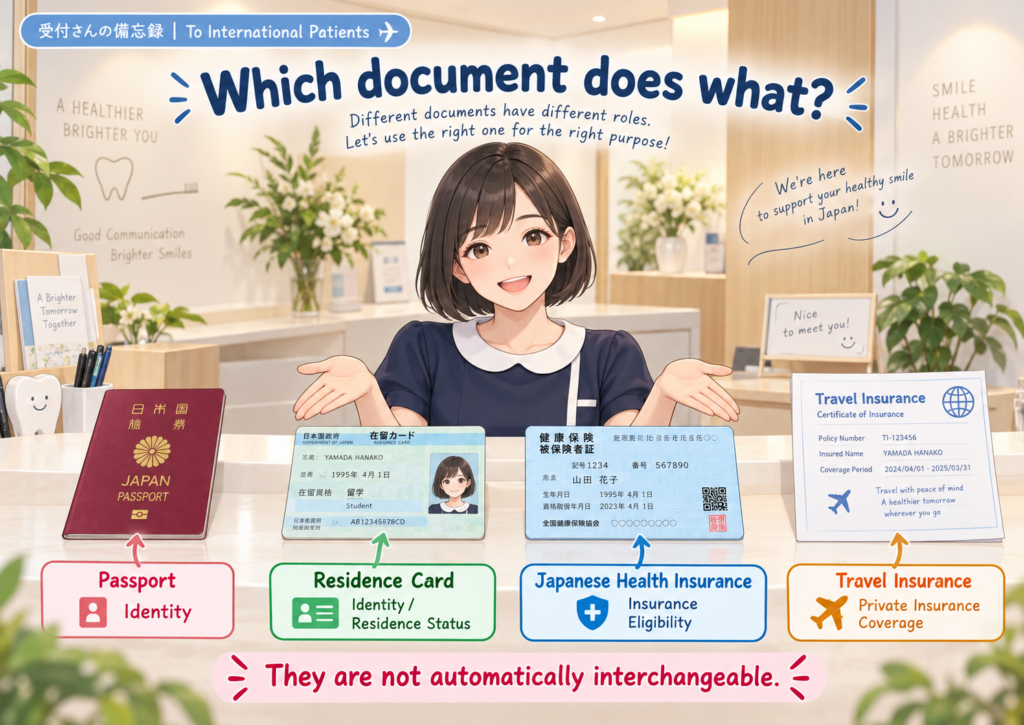
Passport, Residence Card, and Health Insurance Documents Do Different Jobs
This distinction is the most important point to remember.
1. Passport: Mainly for Identification
A passport is primarily a travel and identity document.
For a visitor from overseas who is not enrolled in Japanese public health insurance, a medical institution may use passport information to accurately identify the patient and record necessary information under the Ministry of Health, Labour and Welfare’s guidance for handling overseas visitors.
Depending on the situation, reception staff may also ask for information such as:
- your contact details
- where you are staying in Japan
- how long you expect to remain in Japan
- an emergency contact
- travel or private medical insurance information
- your planned method of payment
But one limitation is very important:
A passport does not by itself prove that you are currently covered by Japanese public health insurance.
A passport can help answer:
“Who are you?”
It does not automatically answer:
“Are you eligible to use Japanese public health insurance today?”
2. Residence Card: Identification and Residence Status
If you live in Japan as a mid- to long-term resident, you may have a Residence Card.
A Residence Card contains information relating to your identity and residence status in Japan.
Ministry of Health, Labour and Welfare guidance also lists a Residence Card as one example of a photo identification document that may be used when an insured medical institution performs identity verification.
However, an ordinary Residence Card and a Japanese health insurance document have different purposes.
You may show your Residence Card and successfully answer:
“Who is this patient?”
But the dental clinic may still need to answer:
“Does this patient currently have valid Japanese public health insurance eligibility?”
An ordinary Residence Card does not automatically answer the second question.
Ordinary Residence Card ≠ Japanese health insurance document
There is an important 2026 exception involving the Specified Residence Card, which we will explain below.
3. Japanese Health Insurance Documents: For Insurance Eligibility
If you are enrolled in Japanese public health insurance and want treatment to be handled under that system, your current insurance eligibility needs to be confirmed.
As of September 2026, patients generally use either:
- a Myna Health Insurance Card
- or a Health Insurance Eligibility Certificate(資格確認書 / shikaku kakunin-sho)
The conventional health insurance cards used in the past all reached the end of their validity by December 1, 2025.
The temporary handling that had allowed an expired conventional health insurance card to be used in certain cases also ended on July 31, 2026.
A Myna Health Insurance Card is a My Number Card that has been registered for health insurance use.
A Health Insurance Eligibility Certificate(資格確認書) is a different document. It allows eligible patients who do not use a Myna Health Insurance Card to confirm their insurance eligibility at a medical institution.
These should also not be confused with another document called the Notice of Eligibility Information(資格情報のお知らせ / shikaku jōhō no oshirase).
The Notice of Eligibility Information normally cannot be used by itself to receive insured care.
For a detailed explanation, see our guide to the Myna Health Insurance Card and Health Insurance Eligibility Certificate at the dental reception desk.
The main point here is simple:
Identity verification and health insurance eligibility verification are different processes.
4. Travel Insurance: A Separate Type of Insurance
Travel insurance belongs to another category altogether.
A travel insurance policy may cover certain medical or dental expenses in Japan, depending on the terms of the individual policy.
Travel insurance is not Japanese public health insurance.
It is also not a substitute for a passport when a clinic needs identity information.
Whether dental treatment is covered may depend on factors such as:
- whether dental treatment is included in the policy
- whether the problem resulted from an accident
- whether emergency dental treatment is covered
- policy exclusions and benefit limits
- whether the insurer requires prior contact
- whether you pay first and claim reimbursement later
- whether a cashless arrangement is available
If you hope to use travel insurance, contact your insurer or assistance company and confirm the procedure that applies to your policy.
A Simple Way to Understand the Four Documents
Passport
Who are you?
Ordinary Residence Card
Who are you, and what is your residence status in Japan?
Japanese health insurance document
Do you currently have Japanese public health insurance eligibility?
Travel insurance
What private insurance coverage may you have?
These documents may all be relevant during the same dental visit, but they are not automatically interchangeable.
If You Are Visiting Japan, What Should You Bring to the Dentist?
Suppose you are in Japan for tourism, business, or another short stay and suddenly need dental treatment.
If you live overseas and are not enrolled in Japanese public health insurance, having your passport available is advisable.
The Ministry of Health, Labour and Welfare’s current materials for preventing unpaid medical bills among overseas visitors who are not enrolled in Japanese public health insurance include passport-based identity confirmation as part of the reception process.
Depending on the clinic and your circumstances, reception staff may also ask for information such as:
- your name and date of birth
- your contact details
- where you are staying in Japan
- the expected duration of your stay
- an emergency contact
- travel insurance information
- payment information
This does not mean that every dental clinic requires every item from every foreign patient.
What needs to be confirmed depends on the patient’s situation and the clinic’s procedures.
If you have travel insurance, it may also be useful to have the insurer’s name, policy information, and assistance-service contact details available.
If you have broken or knocked out a tooth while visiting Japan and need urgent dental care, our separate guide explains what to tell the dental clinic, what to do with a broken tooth fragment or knocked-out tooth, and when medical emergency care may also be necessary.
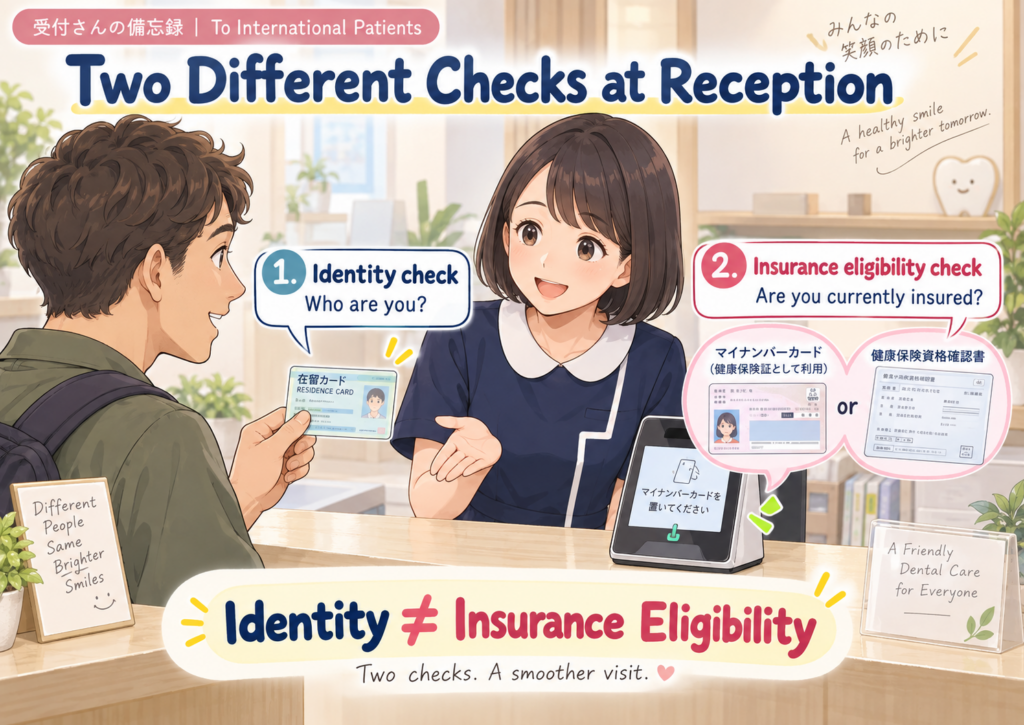
If You Live in Japan, Is Your Residence Card Enough?
This depends on what needs to be confirmed.
For identification, a Residence Card may be relevant.
For Japanese public health insurance eligibility, an ordinary Residence Card serves a different purpose.
Imagine that a patient arrives at reception and says:
“I live in Japan. Here is my Residence Card.”
The card may help confirm the patient’s identity.
But if the patient wants to receive treatment using Japanese public health insurance, reception still needs to confirm whether that insurance eligibility is currently valid.
Identity check
Who are you?
Depending on the situation, a passport, Residence Card, My Number Card, or another appropriate photo ID may be relevant.
Health insurance eligibility check
Are you currently eligible for Japanese public health insurance?
This is generally confirmed through a Myna Health Insurance Card, Health Insurance Eligibility Certificate, or another officially accepted qualification-verification procedure.
Holding a Residence Card does not, by itself, mean that a particular Japanese public health insurance qualification is currently active.
Important 2026 Update: What Is a Specified Residence Card?
There is now an important exception to the simple rule above.
On June 14, 2026, Japan introduced the Specified Residence Card.
The Immigration Services Agency explains that a Specified Residence Card is a Residence Card to which measures have been applied so that My Number Card functions can be incorporated.
This means we now need to distinguish between an ordinary Residence Card and a Specified Residence Card.
They are not the same thing.
An ordinary Residence Card should not simply be described as a health insurance card.
A Specified Residence Card, on the other hand, can also be used as a Myna Health Insurance Card under the applicable My Number health-insurance system.
That does not mean that every Residence Card issued after June 2026 automatically becomes a Myna Health Insurance Card.
The health-insurance-use registration and the validity of the relevant My Number electronic certificate still matter.
So the more accurate question is not:
“Can a Residence Card be used as a health insurance card?”
It is:
“Do I have an ordinary Residence Card, or a Specified Residence Card with the relevant My Number Card functions?”
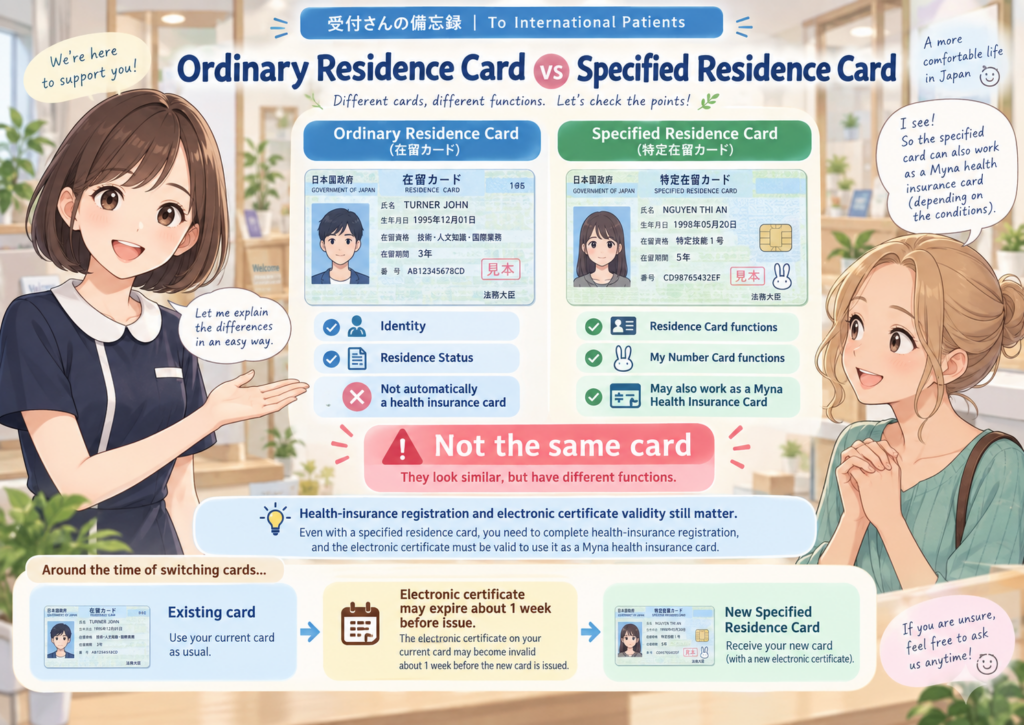
A temporary issue can occur while a new Specified Residence Card is being issued
There is another 2026-specific point worth knowing.
The Immigration Services Agency states that, when a new Specified Residence Card is being issued, the electronic certificate linked to the My Number Card functions of the existing My Number Card or Specified Residence Card will expire approximately one week before the new Specified Residence Card is issued.
This may temporarily affect the use of the card as a Myna Health Insurance Card.
The My Number Card function of a Specified Residence Card can also be affected if the relevant electronic certificate expires in connection with the holder’s period of stay.
If you are in the middle of a Specified Residence Card procedure and your Myna Health Insurance Card suddenly cannot be used, tell the dental reception staff that a new Specified Residence Card is being issued rather than assuming that you no longer have health insurance eligibility.
What Should I Bring If I Use Japanese Public Health Insurance?
If you are enrolled in Japanese public health insurance, bring the method used to confirm your current insurance eligibility.
The main possibilities are:
- Myna Health Insurance Card
- Health Insurance Eligibility Certificate(資格確認書)
The old conventional health insurance cards are no longer the standard method. Their validity ended by December 1, 2025, and the additional temporary handling of expired conventional cards ended on July 31, 2026.
For more information, see our guide to the Myna Health Insurance Card and Health Insurance Eligibility Certificate at the dental reception desk.
That guide also explains the important difference between:
- 資格確認書 — Health Insurance Eligibility Certificate
- 資格情報のお知らせ — Notice of Eligibility Information
These documents do not perform exactly the same function.
Do not assume that showing a passport or ordinary Residence Card automatically completes Japanese health insurance verification.
Is a Residence Card a Substitute for a Myna Health Insurance Card?
For an ordinary Residence Card, generally no.
They serve different purposes.
An ordinary Residence Card can help establish identity and residence status.
A Myna Health Insurance Card is used within the health insurance qualification-verification system.
The important exception is the Specified Residence Card introduced in 2026.
Because a Specified Residence Card can incorporate My Number Card functions, it can also be used as a Myna Health Insurance Card when the relevant requirements are satisfied.
So if reception staff ask what card you have, it may help to say specifically:
“This is an ordinary Residence Card.”
or:
“This is a Specified Residence Card with My Number Card functions.”
What If I Forgot My Passport or Residence Card?
If you forget your passport or Residence Card, do not automatically cancel your dental appointment without contacting the clinic.
First, ask what the clinic needs to confirm.
Is the problem:
- identity cannot be confirmed in the usual way
- or Japanese health insurance eligibility cannot be confirmed?
These are different situations.
There is also an important principle concerning identity verification in insured medical care.
Ministry of Health, Labour and Welfare guidance states that when an insured medical institution chooses to perform identity verification, it should not decide whether to perform that check based on the patient’s nationality.
The same guidance also states that, because not everyone has photo identification, the absence of a photo ID alone should not be the sole reason for denying insured treatment.
This does not mean that a clinic must ignore an identity problem or accept any document in every situation.
It means that:
“I do not have a photo ID with me” and “I cannot receive insured treatment” are not automatically the same statement.
If you are visiting Japan from overseas and the clinic needs your passport information, the procedure may be different from that of a resident using Japanese public health insurance.
A useful phrase when contacting the clinic is:
“I have a dental appointment today, but I do not have my passport with me. Is there another document I should bring?”
Or:
“I live in Japan and have my Residence Card. Do you need any other identification?”
Contacting the clinic is safer than assuming either that you definitely cannot be treated or that no identification will be needed.
What If My Myna Health Insurance Card Cannot Be Used?
This is a different problem from forgetting your passport.
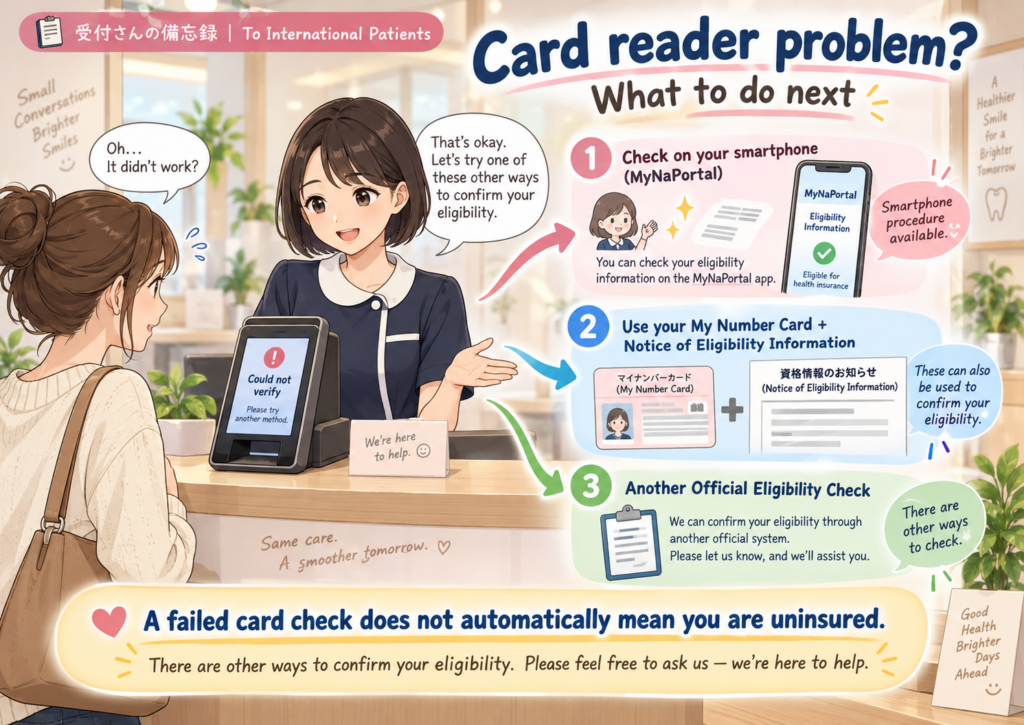
If your Myna Health Insurance Card cannot be processed normally because of a card reader, network, card, or other problem, the Ministry of Health, Labour and Welfare provides alternative methods for confirming valid insurance eligibility.
My Number Card + MyNaPortal eligibility information
If you are using the physical My Number Card, you can present the My Number Card together with the health insurance eligibility information displayed in MyNaPortal.
A previously downloaded PDF of the eligibility information may also be used under the official procedure.
If you are using the smartphone-based Myna Health Insurance Card procedure, the Ministry states that you can log in to MyNaPortal at the reception desk and show the eligibility-information screen. In this smartphone-based situation, presentation of the physical My Number Card is not required for this alternative method.
My Number Card + Notice of Eligibility Information
The Notice of Eligibility Information(資格情報のお知らせ) can also be used together with the My Number Card when normal qualification verification cannot be completed.
However:
The Notice of Eligibility Information normally cannot be used by itself to receive insured treatment.
The Ministry of Health, Labour and Welfare also states that a digital photo or other smartphone copy of the paper Notice of Eligibility Information is not valid for this procedure. The paper notice itself should be presented with the My Number Card.
If these methods are unavailable
Depending on whether it is a first visit or repeat visit and what information the clinic already has, another officially designated procedure may be used.
For example, an initial patient may in some circumstances complete a Declaration of Eligibility Information(被保険者資格申立書).
The important point is:
“The card reader did not confirm my insurance” does not automatically mean “I have no insurance.”
What If My Japanese Health Insurance Has Just Started or Changed?
Foreign residents can encounter the same insurance-transition problems as Japanese residents.
For example:
- you have just started a new job
- you recently changed employers
- you left your previous job
- you became a dependent
- you joined National Health Insurance
- your insurance status recently changed
In these situations, the information shown through the health insurance system may temporarily differ from what you expect.
Your Residence Card does not resolve that issue because residence status and health insurance eligibility are separate matters.
If your insurance information has not yet been updated after changing jobs or insurance, tell the dental clinic that your insurance recently changed.
An old insurance record being displayed does not itself prove that the old insurance qualification is still valid.
Likewise, if new information has not yet appeared, do not automatically assume that you should cancel necessary dental care.
What If I Have Travel Insurance?
Travel insurance can be useful in some situations, but it should be considered separately.
Having travel insurance does not make a passport unnecessary when identity information is required.
A travel insurance card is also not the same as:
- a Myna Health Insurance Card
- a Health Insurance Eligibility Certificate
- an ordinary Residence Card
Travel insurance is private insurance, and coverage depends on the individual policy.
For example, policies may differ regarding:
- emergency dental treatment
- accidental dental injury
- treatment for toothache
- policy exclusions
- maximum benefits
- reimbursement
- prior authorization
- cashless arrangements
“I have travel insurance” does not automatically mean “my dental treatment will be cashless.”
If you plan to use travel insurance, contact your insurer or assistance company and ask what your policy covers and what procedure you need to follow.
Japanese Public Health Insurance Does Not Mean Every Dental Treatment Is Covered
There is another distinction worth making.
Confirming that you have valid Japanese public health insurance does not mean that every possible dental treatment automatically becomes insurance-covered.
These are two different questions:
Question 1: Are you eligible for Japanese public health insurance?
Question 2: Is this particular dental treatment covered by Japanese public health insurance?
A Myna Health Insurance Card can help answer the first question.
It does not turn a treatment that falls outside public insurance coverage into insured treatment.
A patient may therefore have valid Japanese public health insurance and still receive or choose treatment that is self-pay.
For more information, see why having Japanese public health insurance does not mean every dental treatment is covered.
Do I Need to Carry My Passport or Residence Card in Japan Anyway?
This question is related to the topic, but it is legally separate from what a dental clinic needs at reception.
The Immigration Services Agency states that mid- to long-term residents who are subject to the Residence Card carrying requirement generally must carry their Residence Card.
Carrying a passport instead does not normally replace that Residence Card carrying requirement.
There is an important exception for children:
People under 16 years of age are exempt from the requirement to carry a Residence Card at all times.
Special Permanent Residents are also subject to different rules from ordinary Residence Card holders.
The important point for a dental visit is that immigration-law carrying requirements and dental reception procedures are separate questions.
“What am I legally required to carry while I am in Japan?”
and
“What does the dental clinic need to confirm my identity or health insurance eligibility?”
should not be confused.
What Should I Bring to Blanc Dental Clinic?
What is useful to bring depends mainly on whether you are visiting Japan or living here, and whether you use Japanese public health insurance.
If you are visiting Japan
Depending on your situation, it can be useful to have:
- your passport or other appropriate identification
- contact information in Japan
- travel insurance information, if applicable
- information about medications you take
- information about allergies and important medical conditions
If you plan to use travel insurance, you may also need to contact the insurer or assistance company to confirm the procedure that applies to your policy.
If you live in Japan and use Japanese public health insurance
Prepare the appropriate method for confirming your current health insurance eligibility, such as:
- your Myna Health Insurance Card
- your Health Insurance Eligibility Certificate(資格確認書)
If you have a Specified Residence Card, tell reception staff that it has My Number Card functions rather than simply referring to it as a Residence Card.
If your insurance recently started or changed, please let reception know.
If you are not sure what you should bring
You do not need to memorize the Japanese names of every card before contacting us.
You can simply explain:
“I am visiting Japan.”
or:
“I live in Japan and use Japanese public health insurance.”
Then tell us which identification and insurance documents you currently have.
If you are unsure before your visit, you can contact Blanc Dental Clinic through WEB, LINE, or phone.
A Simple Rule to Remember
If the different Japanese documents are becoming confusing, remember these questions.
Passport or ordinary Residence Card
Who are you?
Japanese health insurance document
Are you currently eligible for Japanese public health insurance?
Travel insurance
What private insurance coverage do you have?
In many situations, these are separate questions.
The major 2026 exception is the Specified Residence Card, because it can incorporate My Number Card functions and can therefore also function as a Myna Health Insurance Card when the applicable requirements are satisfied.
So instead of asking only:
“Which one card should I bring?”
it may be more useful to ask:
“What does the dental clinic need to confirm?”
Frequently Asked Questions
Do I always need my passport to see a dentist in Japan?
Not necessarily.
There is no simple nationwide rule that every foreign patient must show a passport at every dental visit.
However, Ministry of Health, Labour and Welfare guidance for medical institutions dealing with overseas visitors who are not enrolled in Japanese public health insurance includes passport-based identity confirmation as part of its reception procedures.
If you are visiting Japan from overseas, having your passport available is therefore advisable.
Can I use my Residence Card instead of my passport?
It depends on why identification is required and on your residence status.
For someone who lives in Japan, a Residence Card may be used as an identity document.
For a visitor from overseas, the clinic may instead need passport information.
If you are unsure, ask the clinic rather than assuming that the documents are interchangeable.
Can I use my Residence Card instead of a health insurance document?
An ordinary Residence Card is not automatically a substitute for Japanese health insurance qualification verification.
Identity and residence status are different from health insurance eligibility.
The important exception is the Specified Residence Card introduced in 2026, which can incorporate My Number Card functions and can also be used as a Myna Health Insurance Card when the applicable requirements are satisfied.
What is a Specified Residence Card?
A Specified Residence Card is a Residence Card to which My Number Card functions can be added.
Japan introduced the system on June 14, 2026.
It should not be confused with an ordinary Residence Card.
The fact that the format of Residence Cards changed in 2026 does not mean that every new-format Residence Card automatically functions as a Myna Health Insurance Card.
Can my Myna Health Insurance Card temporarily stop working while I am getting a Specified Residence Card?
It can be affected during the issuing process.
The Immigration Services Agency states that the electronic certificate associated with the My Number Card functions of the existing card expires approximately one week before a new Specified Residence Card is issued. This may temporarily affect use of the Myna Health Insurance Card.
If this applies to you, tell reception staff that you are in the process of receiving a new Specified Residence Card.
I forgot my passport. Will the dentist refuse to see me?
Do not assume that automatically.
Contact the dental clinic and explain your situation.
For insured medical care, Ministry of Health, Labour and Welfare guidance states that identity verification should not be carried out differently simply because of nationality and that the absence of photo identification alone should not be the sole reason for denying insured treatment.
What the clinic needs to do next depends on the circumstances of your visit.
My Myna Health Insurance Card cannot be read. Do I automatically have to pay the full cost?
Not necessarily.
If normal Myna Health Insurance Card verification cannot be completed, there are alternative official methods for confirming valid insurance eligibility.
- My Number Card + MyNaPortal eligibility information
- My Number Card + Notice of Eligibility Information(資格情報のお知らせ)
- MyNaPortal eligibility information shown through the applicable smartphone procedure
- another designated qualification-confirmation procedure, depending on the circumstances
Ask the reception staff rather than assuming that a failed card-reader check automatically means that you are uninsured.
Can I use the Notice of Eligibility Information by itself?
Normally, no.
The Notice of Eligibility Information(資格情報のお知らせ) is different from a Health Insurance Eligibility Certificate(資格確認書).
When normal Myna Health Insurance Card verification cannot be completed, the paper Notice of Eligibility Information may be presented together with the My Number Card under the official procedure.
A digital photo or smartphone copy of the paper notice is not a substitute for the paper document under this procedure.
Does travel insurance count as Japanese health insurance?
No.
Travel insurance is private insurance and is separate from Japan’s public health insurance system.
Whether dental care is covered, whether you need to pay first, and whether a cashless arrangement is available depend on the terms of your individual policy.
I am a tourist. Should I bring my travel insurance information?
If you have travel insurance, it can be useful to have the insurer’s information available.
If you want to use the policy for dental treatment, contact your insurer or assistance company to confirm whether the treatment is covered and what procedure is required.
Does a child need to carry a Residence Card?
A person under 16 years old is exempt from the general requirement to carry a Residence Card at all times.
However, that immigration rule is separate from what information or documents may be needed for a child’s dental appointment.
Conclusion
When visiting a dentist in Japan, a passport, Residence Card, and health insurance document should not automatically be treated as the same thing.
For a visitor from overseas, a passport may be important for identity confirmation.
For a foreign resident in Japan, an ordinary Residence Card may be useful for identity confirmation, but it does not by itself prove current Japanese public health insurance eligibility.
If you use Japanese public health insurance, your eligibility is generally confirmed through a Myna Health Insurance Card, a Health Insurance Eligibility Certificate(資格確認書), or another officially accepted method.
A Notice of Eligibility Information(資格情報のお知らせ)is another document and should not be confused with the Health Insurance Eligibility Certificate.
Travel insurance is also a separate private insurance arrangement.
And since June 2026, the Specified Residence Card has added an important exception because it can incorporate My Number Card functions.
If you are unsure what to bring to your dental appointment, you do not need to solve the entire Japanese identification and health insurance system yourself.
Tell the clinic:
- whether you are visiting or living in Japan
- whether you use Japanese public health insurance
- what identification and insurance documents you currently have
- whether your insurance recently started or changed
- whether you are in the process of receiving a new Specified Residence Card
Then confirm what is needed for your particular visit.
References
- Ministry of Health, Labour and Welfare. Support materials for medical institutions: preventing unpaid medical bills among overseas visitors. Includes the Reception Procedure Guide for Foreign Visitors, Version 1.2, revised October 9, 2025.
- Ministry of Health, Labour and Welfare. Methods of identity verification at insured medical institutions: re-notification. August 28, 2025.
- Ministry of Health, Labour and Welfare. How to confirm health insurance eligibility. Information on Myna Health Insurance Cards, Health Insurance Eligibility Certificates, MyNaPortal eligibility information, Notices of Eligibility Information, and alternative verification procedures.
- Ministry of Health, Labour and Welfare. Frequently asked questions about using the My Number Card as a health insurance card.
- Ministry of Health, Labour and Welfare. Using the My Number Card as a health insurance card.
- Immigration Services Agency of Japan. What is a Residence Card? Information on the new-format Residence Card and the introduction of the Specified Residence Card from June 14, 2026.
- Immigration Services Agency of Japan. Application for a Specified Residence Card. Includes information on use as a Myna Health Insurance Card, electronic certificates, and temporary effects during card issuance.
- Immigration Services Agency of Japan. Q&A on the Residence Management System. Includes Residence Card carrying requirements and the exemption for people under 16 years of age.