2026年8月31日
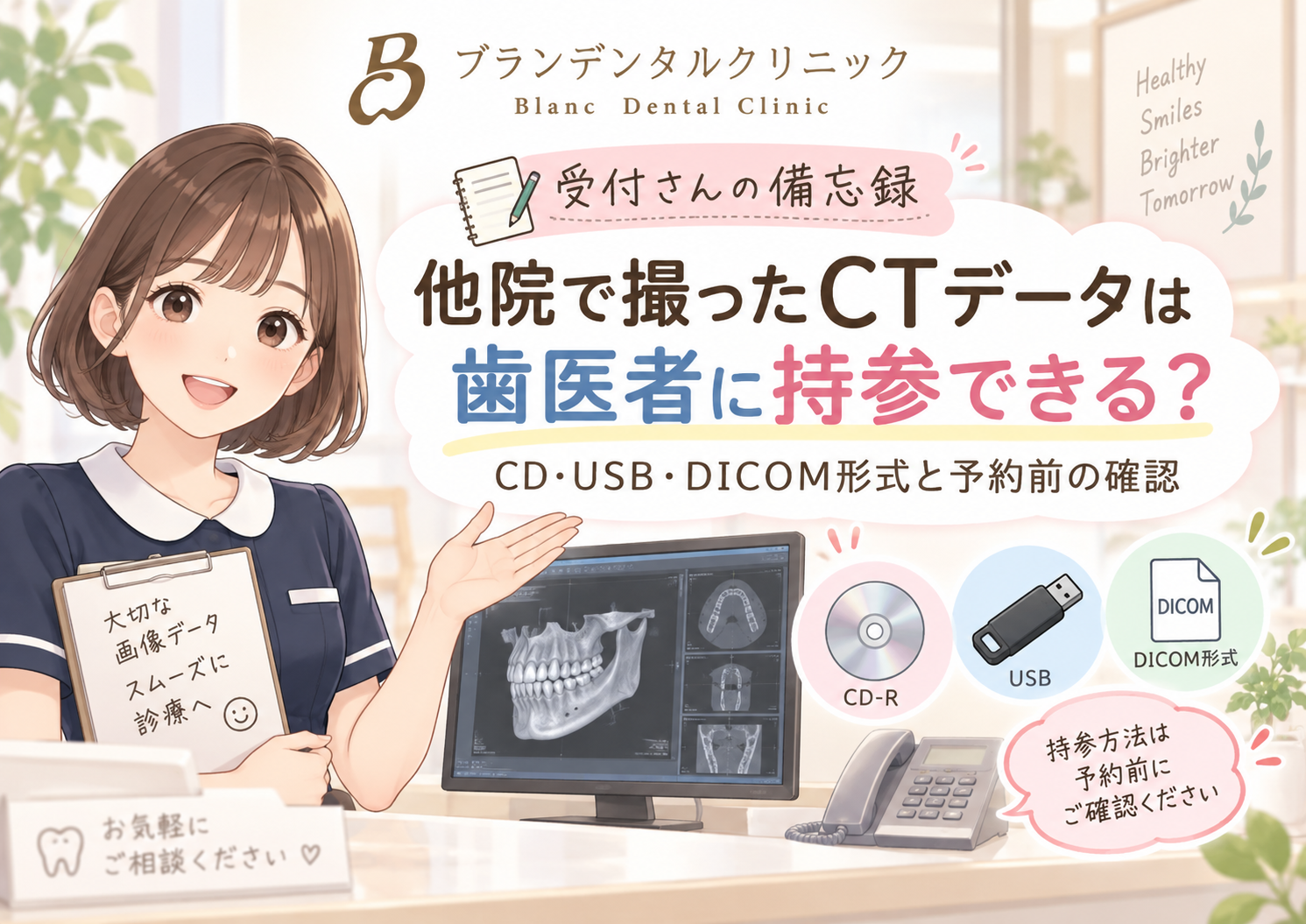
(受付さんの備忘録)
Introduction
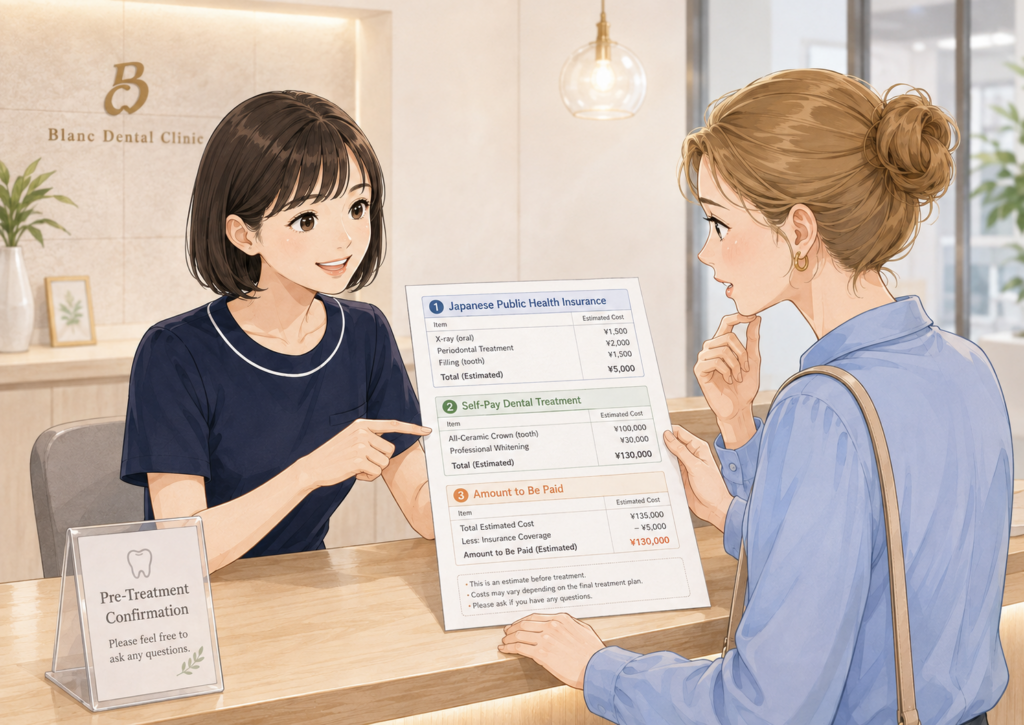
Recently, an international patient asked us an important question at the reception desk after receiving self-pay dental treatment.
The patient was enrolled in Japan’s National Health Insurance and had documentation related to the maximum out-of-pocket amount under the public health insurance system.
At the time of payment, the patient asked:
“I have National Health Insurance and a document about my payment limit. Why do I still have to pay the full cost of this dental treatment?”
This is a very reasonable question if you are unfamiliar with the way Japan’s healthcare system separates insurance-covered treatment from self-pay treatment.
The most important point is simple:
Being enrolled in Japanese public health insurance does not mean that every medical or dental treatment you receive is covered by that insurance.
And if a dental treatment is not covered by Japanese public health insurance, Japan’s High-Cost Medical Expense Benefit does not reduce the self-pay fee simply because the treatment is expensive.
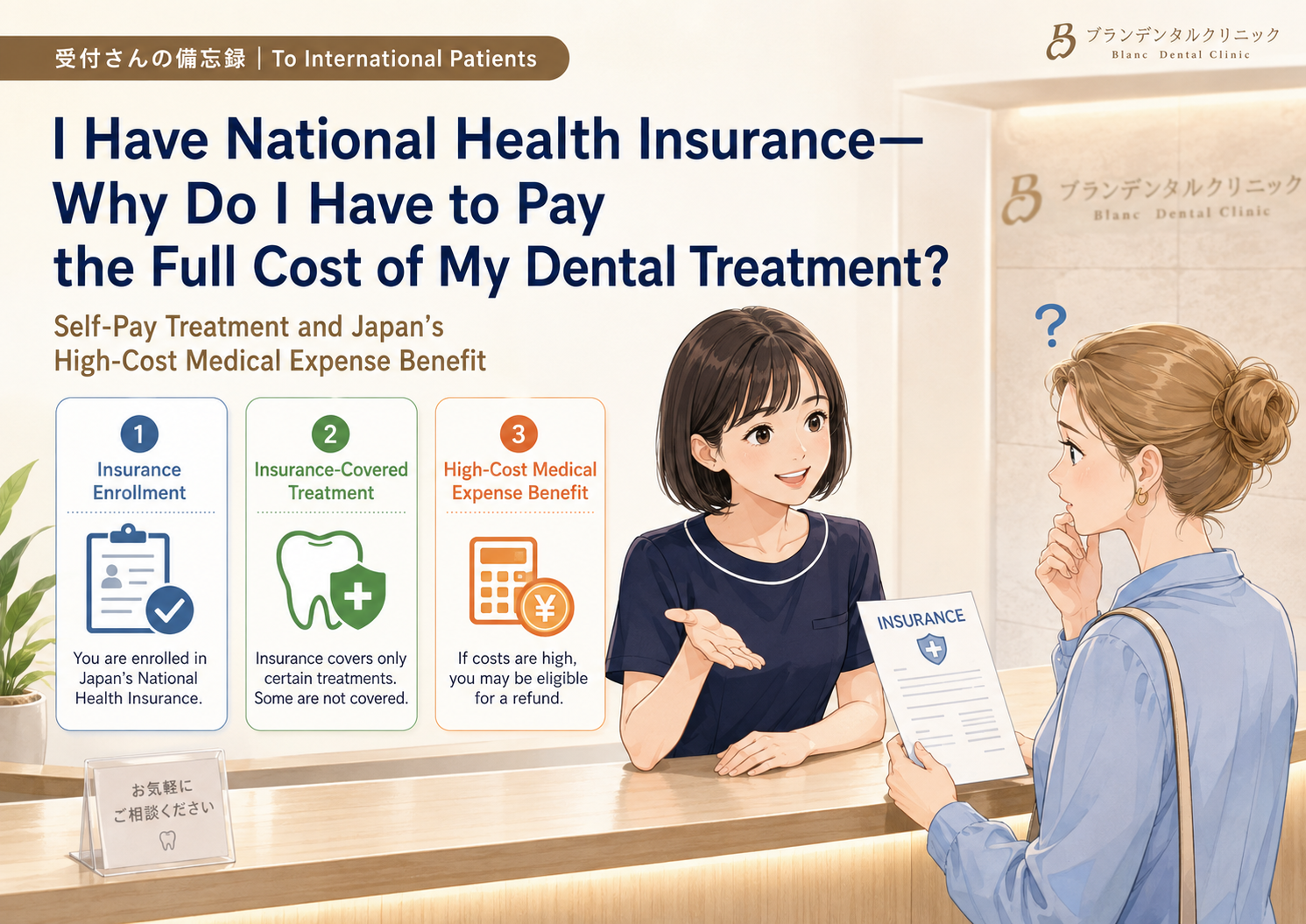
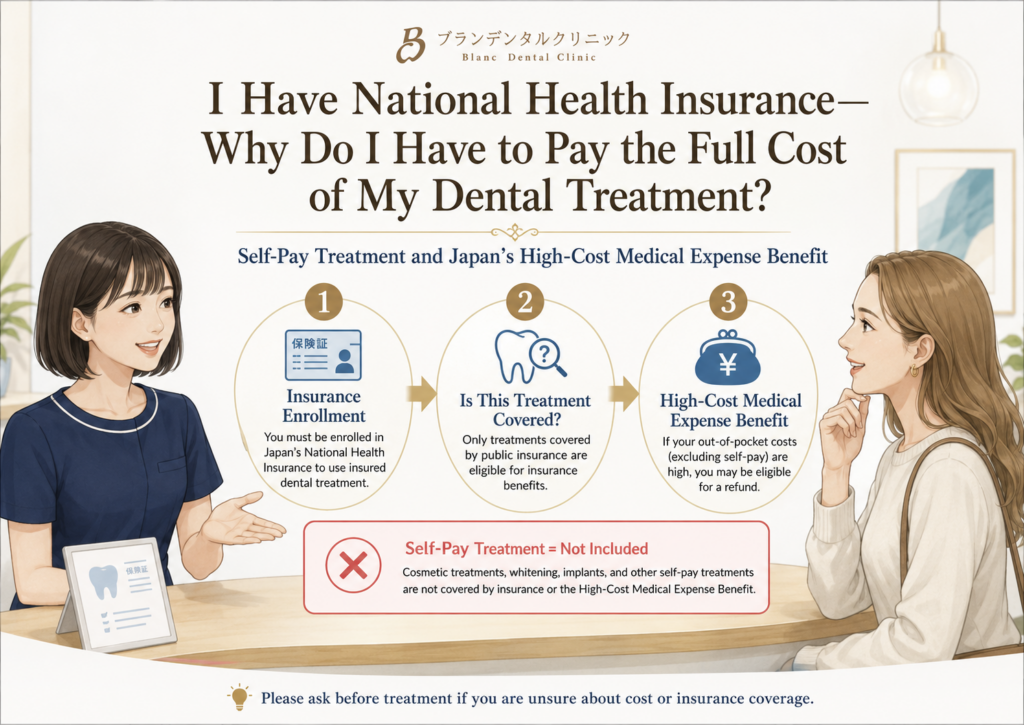
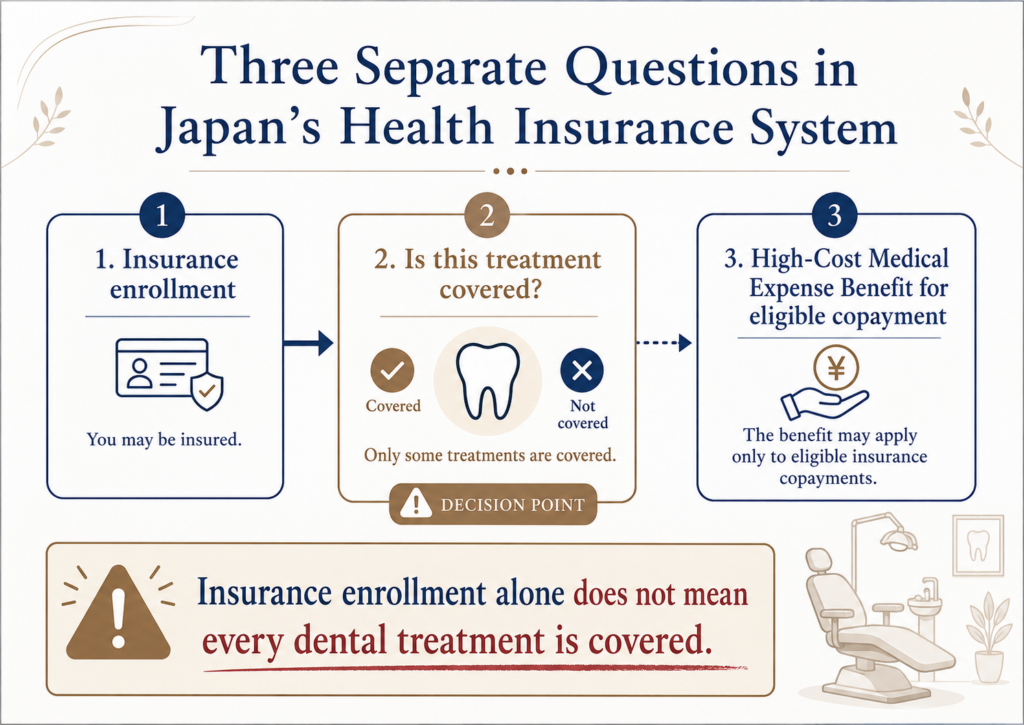
For international patients, it helps to separate three different questions: whether you have Japanese public health insurance, whether the specific treatment is covered by that insurance, and whether the High-Cost Medical Expense Benefit applies to the eligible insurance copayment.
The Short Answer: Having Insurance and Having an Insurance-Covered Treatment Are Not the Same Thing
If your dental treatment is self-pay treatment that is not covered by Japanese public health insurance, the High-Cost Medical Expense Benefit does not reduce that self-pay fee.
This remains true even if you:
- are enrolled in National Health Insurance,
- are enrolled in an employee health insurance plan,
- use a My Number Card registered for use as a health insurance certificate,
- have an Eligibility Certificate for Ceiling-Amount Application, or
- have already been informed of your maximum eligible out-of-pocket amount.
The reason is not that dental care is excluded from Japan’s High-Cost Medical Expense Benefit.
Insurance-covered dental treatment can be included in the public health insurance system. Self-pay dental treatment is excluded because it is outside that system.
That distinction is the key to understanding why a ceiling-amount document does not reduce the fee for self-pay dental treatment.
Three Separate Questions in Japan’s Health Insurance System
A simple way to understand the system is to think about it in three stages.
First: Are you enrolled in Japanese public health insurance?
A patient may be enrolled in National Health Insurance, an employee health insurance plan, or another Japanese public health insurance scheme.
Second: Is this particular treatment covered by Japanese public health insurance?
Not every dental treatment is covered. The diagnosis, treatment method, material, indication, and other requirements can determine whether a treatment is provided as insurance-covered care or self-pay care.
Third: If the treatment is covered, can the High-Cost Medical Expense Benefit apply to the eligible copayment?
If eligible out-of-pocket expenses for insurance-covered medical or dental care become high enough, the High-Cost Medical Expense Benefit may reduce the financial burden according to the applicable rules.
These three stages do not automatically follow one another.
A person can be properly enrolled in National Health Insurance and still receive a treatment that is outside public health insurance coverage.
In that situation, the treatment remains self-pay.
Having an insurance card or insurance eligibility does not convert self-pay treatment into insurance-covered treatment.
International Residents Can Be Enrolled in Japan’s National Health Insurance
This is not a question of nationality.
International residents living in Japan may be enrolled in National Health Insurance if they meet the applicable requirements.
Hiroshima City’s National Health Insurance guidance explains that residents of Hiroshima City, including foreign residents, are generally subject to National Health Insurance enrollment unless they are covered by another health insurance scheme or fall within an applicable exclusion.
So when an international patient says:
“I have Japanese National Health Insurance.”
that may be completely correct.
The next question is:
“Is the dental treatment I am receiving covered by that insurance?”
For a broader explanation of this distinction, you can also read our guide on when insurance-covered and self-pay dental treatment are explained.
What Is Japan’s High-Cost Medical Expense Benefit?
Japan’s High-Cost Medical Expense Benefit is designed to reduce the financial burden when eligible out-of-pocket expenses for treatment covered by public health insurance become high.
The Ministry of Health, Labour and Welfare uses the English term “High-Cost Medical Expense Benefit” for 高額療養費制度.
The official English term used for 限度額適用認定証 is “Eligibility Certificate for Ceiling-Amount Application.”
In practical terms, eligible out-of-pocket costs for insurance-covered care may be limited according to rules that depend on factors such as age, income, and the current public insurance rules.
However, the words “high-cost” can easily cause a misunderstanding.
The system does not mean:
“Any expensive medical or dental treatment will have a maximum price.”
Instead, it means that a ceiling may apply to eligible expenses within Japan’s public health insurance system.
Self-pay treatment that is outside public health insurance is not brought into that system simply because the amount is high.
Self-Pay Dental Fees Are Not Added to the High-Cost Medical Expense Calculation
This is one of the most important points for patients who receive both insurance-covered and self-pay dental treatment.
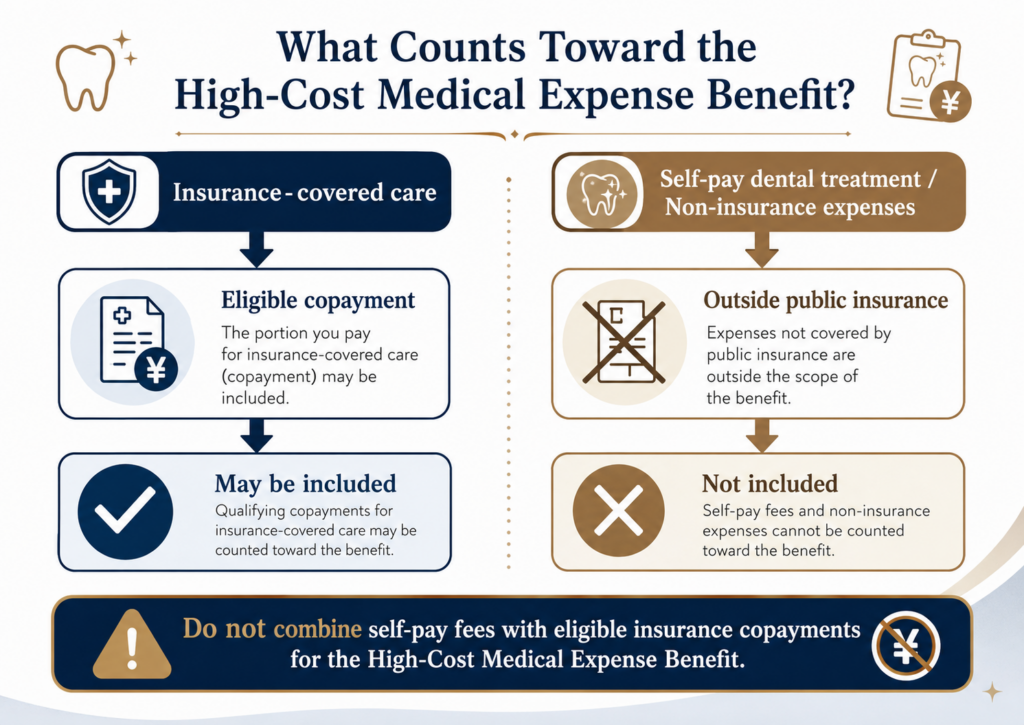
Suppose you receive insurance-covered dental treatment and also receive a more expensive self-pay treatment during the same month.
The self-pay fee is not simply added to your insurance-covered copayment to increase the amount used for the High-Cost Medical Expense Benefit.
Hiroshima City’s guidance on the High-Cost Medical Expense Benefit calculates the benefit on the basis of medical expenses for insurance-covered care and excludes charges that are not covered by public health insurance.
So the calculation is not:
insurance-covered copayment + self-pay dental fee = amount used for the High-Cost Medical Expense Benefit
The self-pay portion remains outside the public health insurance calculation.
Dental Treatment Itself Is Not Excluded
Another misunderstanding sometimes occurs after patients hear that a self-pay dental treatment is not included.
They may conclude:
“The High-Cost Medical Expense Benefit cannot be used at a dental clinic.”
That is not correct.
The important distinction is not dentistry versus medicine.
The important distinction is insurance-covered care versus care that is not covered by public health insurance.
If a dental treatment is covered by Japanese public health insurance and the other requirements for the High-Cost Medical Expense Benefit are met, eligible dental copayments can be handled within the public health insurance system.
The self-pay portion is excluded because it is outside public insurance coverage—not simply because the treatment was provided by a dentist.
A My Number Card Does Not Turn Self-Pay Treatment Into Insurance-Covered Treatment
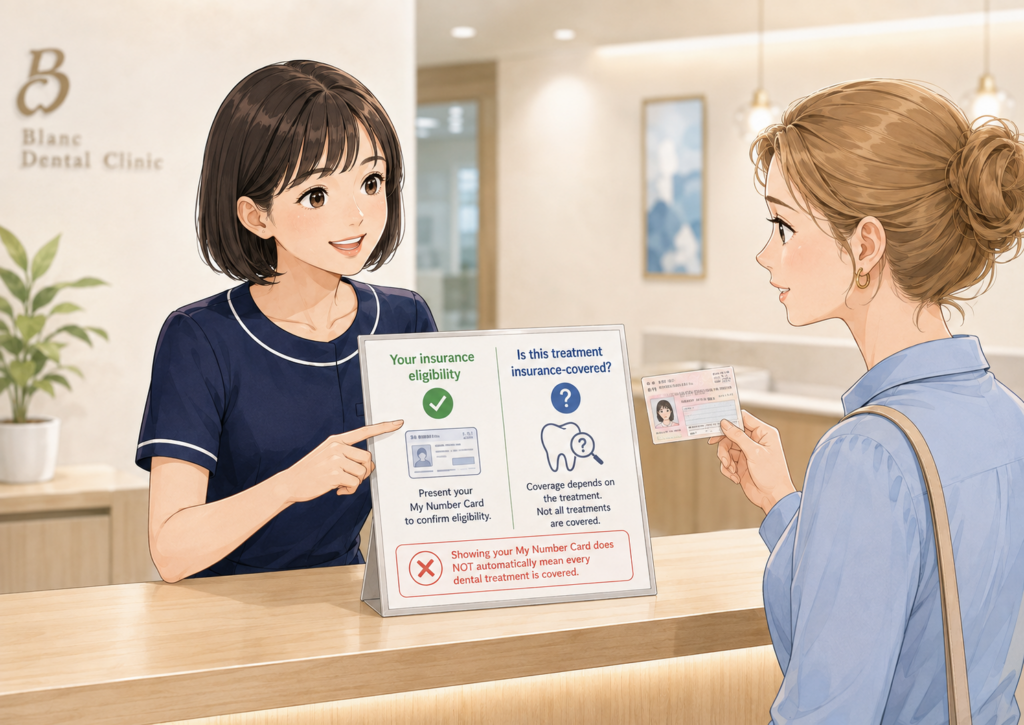
A My Number Card registered for use as a health insurance certificate can make it easier to confirm insurance eligibility and use applicable public insurance benefits.
In many situations, patients using a My Number Card as a health insurance certificate do not need to separately present an Eligibility Certificate for Ceiling-Amount Application in order to have the applicable ceiling reflected at the medical institution for eligible insurance-covered care.
However, there is an important limitation.
Your My Number Card does not decide whether a dental treatment is covered by public health insurance.
It can help confirm your insurance status and apply insurance benefits that are available to you.
It does not change the legal or insurance classification of a self-pay treatment.
In other words:
A My Number Card can help confirm and use insurance benefits. It cannot turn a treatment outside public insurance coverage into insurance-covered treatment.
The same principle applies to a ceiling-amount certificate.
For more information about documents used at dental reception, see our guide to My Number Cards and eligibility certificates at the dental clinic.
Japan Revised the High-Cost Medical Expense Benefit in August 2026
Japan revised the High-Cost Medical Expense Benefit beginning with treatment provided in August 2026.
The Ministry of Health, Labour and Welfare explains that monthly ceiling amounts were revised from August 2026 and that an annual ceiling was also introduced.
This means that patients who have used the system in the past may find that their applicable limits or categories have changed.
Because the applicable limit depends on factors such as age, income, and the current rules, patients should check the limit that applies to their own situation.
However, one fundamental point remains the same:
The High-Cost Medical Expense Benefit applies within Japan’s public health insurance system. A self-pay dental fee does not become eligible simply because it is expensive.
Why Can This Be Confusing for International Patients?
Healthcare systems differ greatly between countries.
Some patients come from countries where most healthcare costs are paid through taxation. Others are familiar with private insurance systems, employer-sponsored insurance, annual deductibles, reimbursement systems, or maximum annual out-of-pocket limits.
Words such as “insurance,” “covered,” “limit,” “self-pay,” and “reimbursement” may therefore suggest something very different depending on the patient’s previous experience.
A patient may correctly understand that a treatment is “self-pay” and still assume:
“I will pay now, but Japanese National Health Insurance will reimburse part of it later.”
Or the patient may think:
“I have a document showing my maximum payment, so I cannot be charged more than that amount.”
Neither assumption necessarily applies to a self-pay dental treatment.
A Japanese study of international students found that dental care avoidance was associated with factors including Japanese-language ability and oral health literacy. The researchers suggested language support, simpler terminology, and the use of “easy Japanese” as possible ways to improve communication.
The important lesson is not that international patients “do not understand.”
It is that a healthcare system cannot always be explained simply by translating technical words from one language into another.
The meaning of the system also needs to be explained.
The Ministry of Health, Labour and Welfare also provides multilingual medical information materials for international patients, reflecting the importance of clear communication across languages in Japanese healthcare settings.
“Self-Pay” Means More Than “You Have to Pay Today”
The phrase “self-pay treatment” can itself cause confusion.
In this article, self-pay dental treatment means treatment that is not being provided as a benefit under Japanese public health insurance.
It does not simply mean:
“You need to pay money at the reception desk today.”
Patients usually also pay a copayment at reception when they receive insurance-covered treatment.
So there are two very different types of payment:
- a patient copayment for treatment covered by Japanese public health insurance, and
- a fee for treatment that is outside Japanese public health insurance coverage.
Both may involve paying money to the dental clinic.
But they are not treated the same way by the public insurance system.
Similar Dental Treatments May Have Different Insurance Status
This can be particularly confusing in dentistry because treatments that look similar to a patient may have different insurance classifications.
A white dental restoration is not automatically self-pay simply because it is white.
Likewise, a treatment is not automatically covered just because it is medically useful.
For example, ordinary implant treatment for a missing tooth is generally outside Japanese public health insurance coverage.
Tooth whitening performed to lighten the color of teeth is generally self-pay.
Most orthodontic treatment is also self-pay, although certain conditions and specific types of malocclusion can qualify for public insurance coverage under defined rules.
Materials, diagnosis, treatment method, clinical indication, and other requirements may all affect whether a specific dental treatment is insurance-covered.
For that reason, it is safer to ask about the specific treatment being proposed rather than assume that every crown, white restoration, orthodontic treatment, implant, or dental surgery is always treated the same way.
Can Insurance-Covered and Self-Pay Treatment Simply Be Mixed Together?
Not freely.
Japan does have legally defined systems that allow certain combinations of insurance-covered and non-insurance care under specific conditions.
The Ministry of Health, Labour and Welfare explains these exceptions under the system for permitted combinations of insurance-covered and non-insurance care, including categories such as Evaluation Treatment, Patient-Proposed Health Services, and Selected Treatment.
However, this does not mean that a patient or dental clinic can freely choose to make one convenient part of any self-pay treatment insurance-covered while leaving another part self-pay.
Japanese public health insurance has specific rules about what can and cannot be combined.
For most patients, the practical rule is simple:
Do not assume that insurance-covered and self-pay fees can be freely combined. Ask how the specific treatment will be billed before treatment begins.
Four Questions to Ask Before Starting Self-Pay Dental Treatment
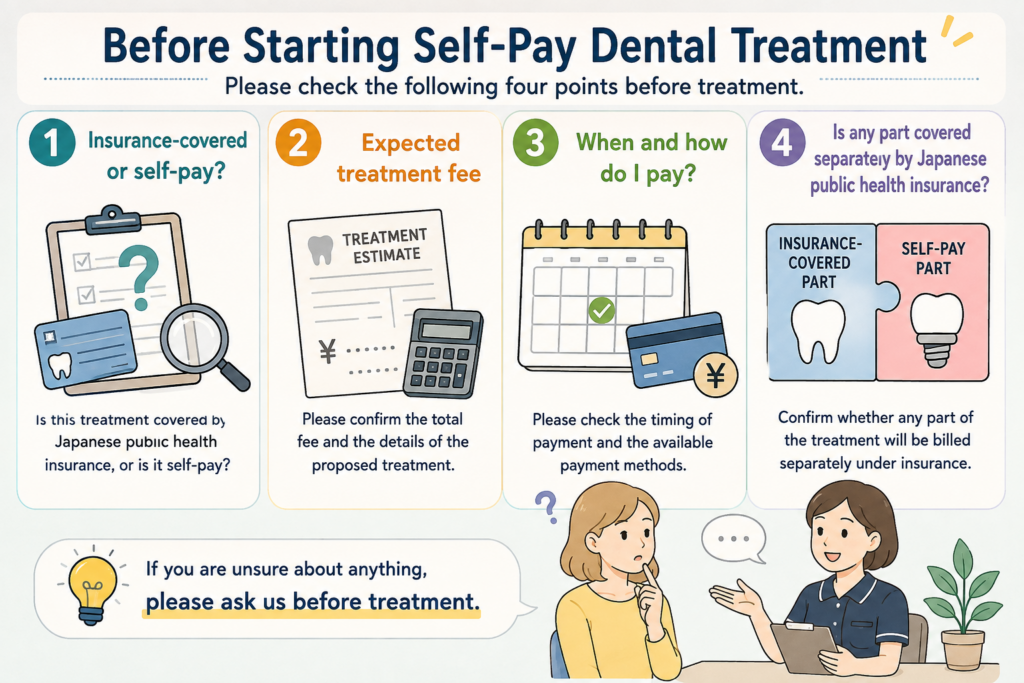
Before starting a self-pay dental treatment, it is helpful to make sure that you understand four things.
- Is this treatment covered by Japanese public health insurance, or is it self-pay?
- What is the expected treatment fee?
- When and how will payment be made?
- Is any part of the proposed treatment being billed separately under public health insurance?
A Short Explanation You May Hear at Reception
When a patient only needs the essential point, a short explanation may be clearer than a long discussion of Japanese insurance terminology.
This treatment is not covered by Japanese public health insurance.
You may be enrolled in National Health Insurance, but that does not mean every dental treatment is covered.
Japan’s High-Cost Medical Expense Benefit applies to eligible expenses for insurance-covered care. It does not reduce this self-pay treatment fee.
Your My Number Card or a ceiling-amount document does not change self-pay treatment into insurance-covered treatment.
If you are unsure about the treatment fee or insurance coverage, please ask us before treatment.
If You Have Private Insurance, Travel Insurance, or Insurance From Another Country
Japanese public health insurance and private insurance are separate systems.
An international patient may have Japanese National Health Insurance and also have private medical insurance, travel insurance, employer-sponsored international insurance, or coverage from another country.
A private insurer may reimburse some dental costs depending on the individual policy.
However, that does not change the way the dental treatment is classified under Japanese public health insurance.
A self-pay dental treatment remains self-pay within the Japanese public insurance system even if a private insurer later reimburses the patient.
If you intend to claim reimbursement from a private or overseas insurer, contact the insurer before treatment whenever possible.
Ask what dental treatments are covered and what documents are required.
Depending on the insurer, you may be asked to provide receipts, detailed treatment information, certificates, claim forms, or other documents.
The dental clinic can provide the treatment and payment information it is able to document, but the private insurer makes the final decision about reimbursement under its own policy.
The High-Cost Medical Expense Benefit and Japan’s Medical Expense Deduction Are Different
Another common source of confusion is Japan’s medical expense tax deduction.
The High-Cost Medical Expense Benefit is part of Japan’s public health insurance system.
The medical expense deduction is part of Japan’s tax system.
They are not the same benefit.
A self-pay dental treatment that is excluded from the High-Cost Medical Expense Benefit is not automatically excluded from the medical expense deduction.
The National Tax Agency explains that certain dental treatments not covered by public insurance may still qualify for the medical expense deduction when the relevant requirements are met.
However, treatment performed solely for cosmetic purposes may be treated differently, and individual tax eligibility depends on the patient’s circumstances.
A dental clinic can explain what treatment was provided and how much was paid, but it cannot make the final tax determination for an individual patient.
If necessary, please confirm your eligibility with the Japanese tax authorities or a qualified tax professional.
For more information, see our guide to self-pay ceramic dental treatment and Japan’s medical expense deduction.
Please keep your dental receipts.
Frequently Asked Questions
I Have National Health Insurance. Do I Still Have to Pay the Full Self-Pay Dental Fee?
Yes.
If the treatment you are receiving is not covered by Japanese public health insurance, you are responsible for the self-pay treatment fee explained by the dental clinic.
Your National Health Insurance enrollment may be completely valid, but that insurance applies only when the treatment itself meets the requirements for public insurance coverage.
I Have a Ceiling-Amount Certificate. Can I Get the Self-Pay Fee Refunded Later?
Not through the High-Cost Medical Expense Benefit.
The certificate is connected to eligible expenses under Japanese public health insurance.
It does not make a self-pay dental fee eligible for the High-Cost Medical Expense Benefit.
I Paid for Insurance-Covered Dental Treatment and Self-Pay Treatment in the Same Month. Are Both Added Together?
No.
The self-pay portion is outside the public health insurance calculation and is not simply added to your eligible insurance-covered copayments because both payments happened during the same month.
I Used My My Number Card. Why Was the Self-Pay Fee Not Reduced?
Because your My Number Card does not determine whether a treatment is insurance-covered.
It can help confirm your insurance eligibility and apply benefits that are available for eligible insurance-covered care.
It cannot convert a self-pay treatment into insurance-covered treatment.
Does the High-Cost Medical Expense Benefit Not Apply to Dental Clinics?
Dental treatment itself is not excluded.
The important question is whether the specific dental treatment is covered by Japanese public health insurance.
Self-pay treatment is excluded because it is outside public insurance coverage, not simply because it is dental treatment.
My Overseas Insurance Company Says My Dental Treatment Is Covered. Does That Mean Japanese National Health Insurance Also Covers It?
No.
Coverage under a private or overseas insurance policy and coverage under Japanese public health insurance are separate questions.
Your private insurer may reimburse you according to its own policy, but that does not change the treatment’s status under Japanese public health insurance.
Can I Ask About Insurance and the Total Fee Before Treatment?
Yes.
You are welcome to ask:
- “Is this covered by Japanese public health insurance?”
- “Is this self-pay treatment?”
- “How much will I need to pay?”
- “Does the High-Cost Medical Expense Benefit apply to this treatment?”
It is better to clarify these questions before treatment than to discover a misunderstanding at the payment desk.
What We Learned at the Reception Desk
The question we received at the reception desk highlighted an important gap that can occur even when a dental clinic believes it has explained that treatment is self-pay.
A clinic may say:
“This is self-pay treatment.”
But the patient may understand that statement as:
“I have to pay the fee now, but my Japanese insurance or ceiling-amount benefit will reduce or reimburse it later.”
Those are very different understandings of the same conversation.
For international patients, translating the terms “self-pay,” “National Health Insurance,” or “High-Cost Medical Expense Benefit” may not be enough.
A clearer explanation is:
You have Japanese health insurance.
However, this particular treatment is outside the coverage of that insurance.
Because it is outside the public insurance system, the High-Cost Medical Expense Benefit does not reduce this self-pay fee.
That is the distinction we want patients to understand before treatment begins.
For International Patients Visiting Blanc Dental Clinic in Hiroshima
Blanc Dental Clinic is located on the 4th floor of Tatemachi Chuo Building in Naka Ward, Hiroshima City, about a one-minute walk from the Hiroshima Electric Railway Tatemachi stop.
An elevator is available to the 4th floor, and the Sukiya restaurant on the 1st floor of the building is an easy landmark.
If you are visiting for the first time and are enrolled in Japanese public health insurance, please bring your My Number Card registered for use as a health insurance certificate or another document that can be used to confirm your eligibility, as applicable.
You can read more about your first visit in our guide to visiting Blanc Dental Clinic at Tatemachi Chuo Building.
If you are considering self-pay dental treatment, please ask about the treatment fee, payment timing, and payment methods before proceeding.
Our guide to payment methods at Blanc Dental Clinic also explains the available payment options.
If you suddenly develop tooth pain, swelling, dental trauma, a lost filling, a lost temporary crown, or another urgent dental problem while you are in Hiroshima, same-day urgent dental care may be possible depending on the schedule.
Same-day phone reception is available for urgent consultations, and calling is recommended so that our reception team can check the current schedule and advise you. You can also read our guide to finding same-day urgent dental care in Hiroshima City’s Naka Ward.
Summary: Having Insurance Does Not Mean Every Dental Treatment Is Insurance-Covered
The most important point is simple:
Being enrolled in Japanese public health insurance does not mean that every dental treatment is covered by Japanese public health insurance.
The High-Cost Medical Expense Benefit applies to eligible out-of-pocket costs within the public health insurance system.
It does not act as a discount for self-pay dental treatment.
A My Number Card, an Eligibility Certificate for Ceiling-Amount Application, or information about your applicable ceiling does not change a self-pay treatment into insurance-covered treatment.
If you pay for both insurance-covered and self-pay care, the self-pay fee is not simply added to your eligible insurance copayments for the High-Cost Medical Expense Benefit.
At the same time, a self-pay dental treatment may be relevant to a separate private insurance claim or, depending on your individual circumstances, Japan’s medical expense tax deduction.
If you are uncertain, please ask one question before treatment:
“Is this treatment covered by Japanese public health insurance, or is it self-pay?”
Clarifying that point before treatment can prevent a major misunderstanding at the payment desk.
References and Official Information
- Ministry of Health, Labour and Welfare, Japan. High-Cost Medical Expense Benefit. Information updated for the August 2026 revision.
- Ministry of Health, Labour and Welfare, Japan. High-Cost Medical Expense Benefit / Eligibility Certificate for Ceiling-Amount Application. English information material for international patients.
- Ministry of Health, Labour and Welfare, Japan. Information on using the My Number Card as a health insurance certificate.
- Hiroshima City. National Health Insurance enrollment information, including information applicable to foreign residents.
- Hiroshima City. High-Cost Medical Expense Benefit under Hiroshima City National Health Insurance.
- Ministry of Health, Labour and Welfare, Japan. Multilingual medical information materials for international patients.
- Ministry of Health, Labour and Welfare, Japan. Information on permitted combinations of insurance-covered and non-insurance care.
- National Tax Agency, Japan. Specific examples of dental treatment expenses eligible for the medical expense deduction.
- Iwasaki Y, Adachi N, Shinada Y. Study on dental health behavior and dental attendance among international students in Japan. Japanese Society of Dental Hygiene, Vol. 19, No. 1, Poster P-95.