2026年9月09日
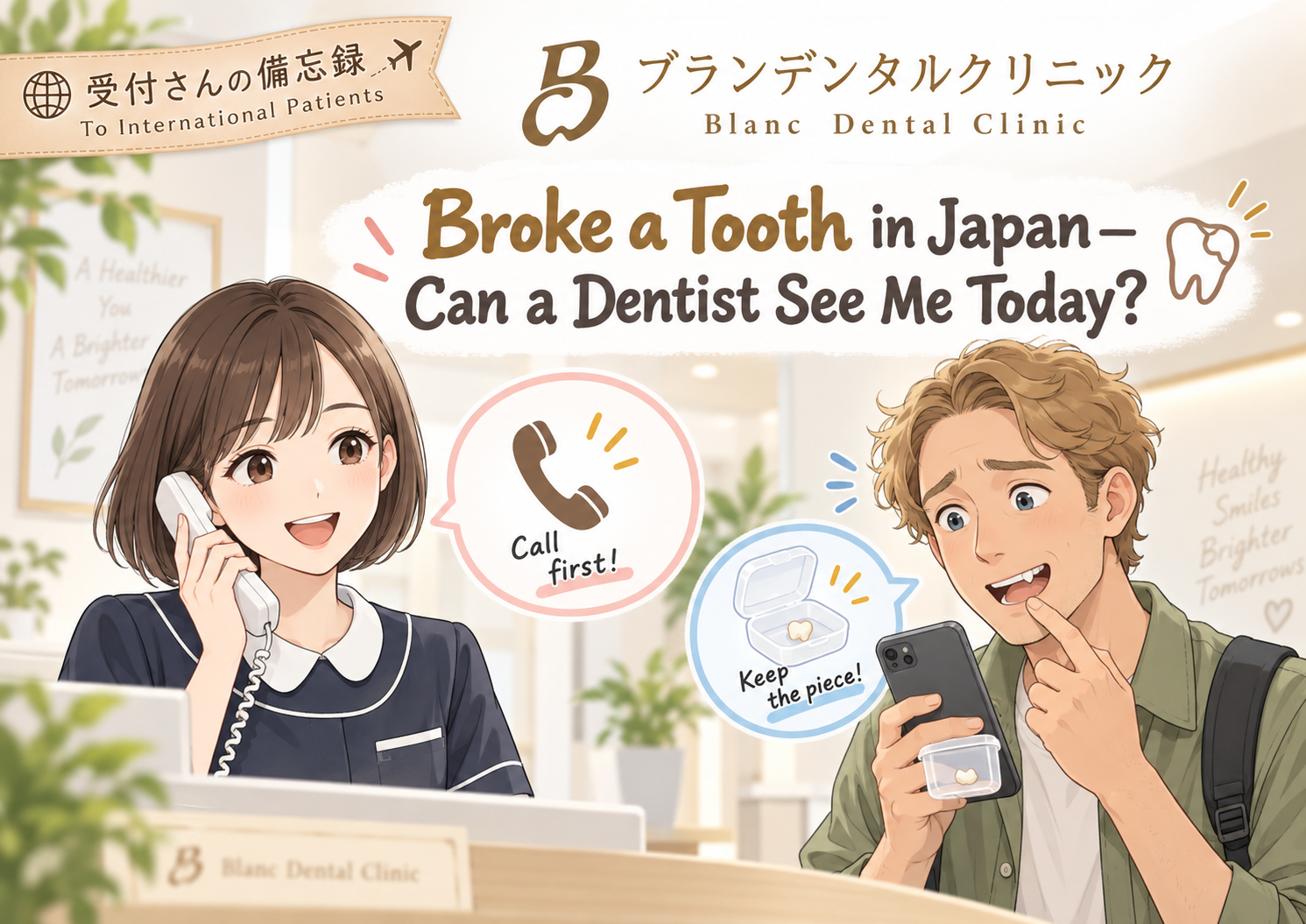
(受付さんの備忘録:Reception Desk Notes | To International Patients)
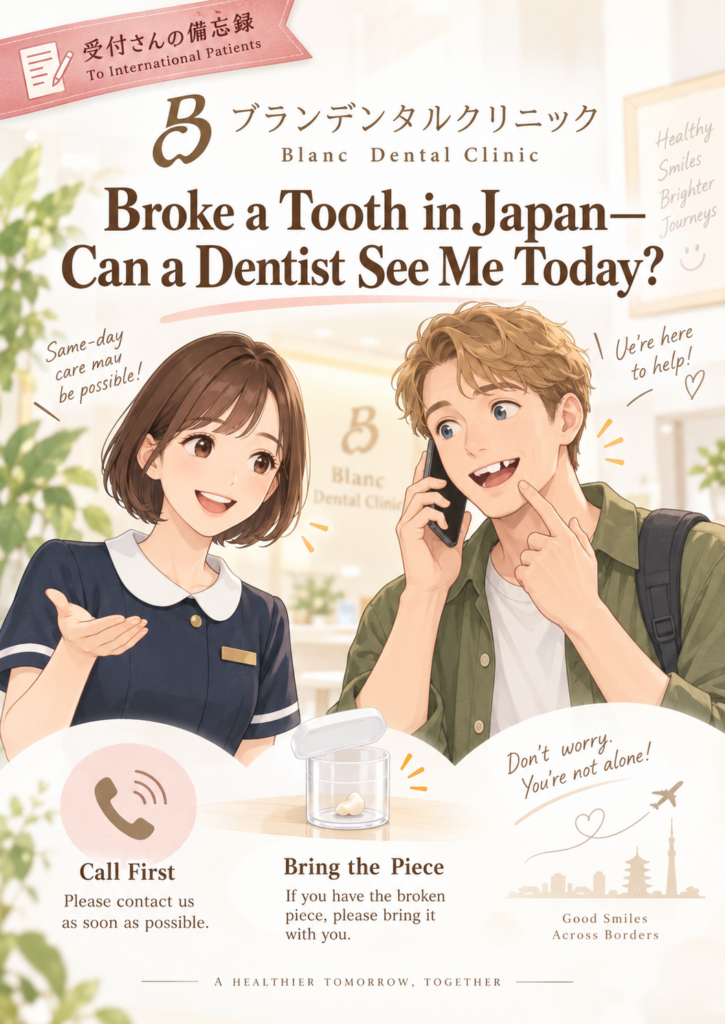
Introduction
You are visiting Japan, on a business trip, studying here, or living in Japan—and suddenly part of your tooth breaks.
Maybe you fell and hit your front teeth. Maybe you bit something hard. Maybe a tooth chipped while you were eating. Or perhaps you are not even sure whether it was your natural tooth, a filling, or a crown that broke.
The first question is usually simple:
Can a dentist in Japan see me today?
The answer is: possibly, yes.
Many dental clinics in Japan work mainly by appointment, so being open does not necessarily mean that a dentist can see you immediately as a walk-in patient. However, a broken, loose, displaced, or knocked-out tooth may need prompt assessment, and some clinics can arrange a same-day urgent visit depending on the appointment schedule and the nature of the injury.
If you have just injured a tooth, calling the dental clinic first is usually the best first step.
Tell the receptionist what happened, when it happened, whether the tooth is loose or out of position, whether you still have the broken piece, and whether there is bleeding, swelling, or severe pain.
One important point is that a same-day dental visit does not always mean that the entire treatment can be completed on the same day. The first priority is to determine what has happened to the tooth and surrounding tissues and decide what treatment is needed now and what may need to be done later.
If the entire permanent tooth has come out of the socket, this is more time-sensitive than an ordinary chip or fracture. Please go directly to the section below on a completely knocked-out tooth.
Broke a Tooth in Japan? Call a Dentist First
If your tooth breaks while you are in Japan, you do not need to wait until you return to your home country before asking a dentist for help.
You also do not need to know the exact dental diagnosis before you call.
From the reception desk’s point of view, one of the most useful things you can tell us is simply what happened.
- “I fell and hit my front tooth.”
- “I bit something hard and part of my tooth broke.”
- “My tooth broke about 30 minutes ago.”
- “My front tooth is moving after I hit it.”
- “The whole tooth came out.”
These details can be more useful than trying to decide for yourself whether you have a “small chip,” a “deep fracture,” or a “cracked tooth.”
Dental injuries vary greatly in severity. Some involve only the outer enamel. Others reach the dentin underneath, expose the pulp inside the tooth, extend below the gum line, involve the root, or occur together with an injury that moves the tooth within its socket.
This is why a tooth that looks only slightly damaged from the outside may still need a dental examination.
If you are looking for urgent dental care in central Hiroshima, you can also read our guide to finding a same-day dentist in Hiroshima City and what to tell the receptionist.
When the injury has just happened, however, it is usually better to contact a dental clinic promptly rather than spending a long time comparing multiple clinics online.
What Should I Tell the Dental Receptionist?
You do not need perfect English or perfect Japanese to explain a dental injury.
Start with the event itself.
Tell Us When It Happened
The time of the injury is important, particularly when a tooth has moved from its original position or has completely come out.
Try to remember whether it happened:
- a few minutes ago
- about an hour ago
- this morning
- yesterday
- several days ago
You do not need to know the exact minute, but the more accurate your estimate, the better.
Tell Us Which Tooth Was Injured
You can say:
- “My upper front tooth.”
- “My lower front tooth.”
- “A back tooth on the right side.”
If you cannot tell exactly which tooth is damaged, that is also fine. You can simply say, “I think one of my upper front teeth broke.”
Tell Us Whether a Piece Broke Off or the Whole Tooth Came Out
This is a particularly important distinction.
A tooth with a broken corner is not the same injury as a permanent tooth that has completely come out of its socket.
If you are unsure, tell the receptionist exactly what you see.
- “Part of the tooth is missing.”
- “I found a small white piece.”
- “The tooth is still there, but it is loose.”
- “The whole tooth came out.”
Tell Us About Movement, Bleeding, Swelling, and Pain
Useful information includes:
- Is the tooth loose?
- Does it look longer or shorter than before?
- Has it moved forward, backward, or sideways?
- Does your bite suddenly feel different?
- Is the gum bleeding?
- Is your lip or cheek cut?
- Is there swelling?
- Is the pain mild, moderate, or severe?
- Does cold air or water cause sharp pain?
- Can you see a red or pink area inside the broken tooth?
You do not need to repeatedly touch or wiggle the tooth to check whether it moves. Just tell us what you have already noticed.
Tell Us How the Injury Happened
A fall, sports injury, bicycle accident, traffic accident, collision, or blow to the face may involve more than the visible tooth fracture.
If you also hit your head, jaw, nose, or face, tell the dental clinic.
Also tell the receptionist if the injury happened in a traffic accident, at work, at school, or during an organized sports activity. Depending on how the injury occurred, insurance, workers’ compensation, school-related procedures, or other administrative arrangements may differ. You do not need to work out those systems yourself before calling; simply tell the clinic how the injury happened.
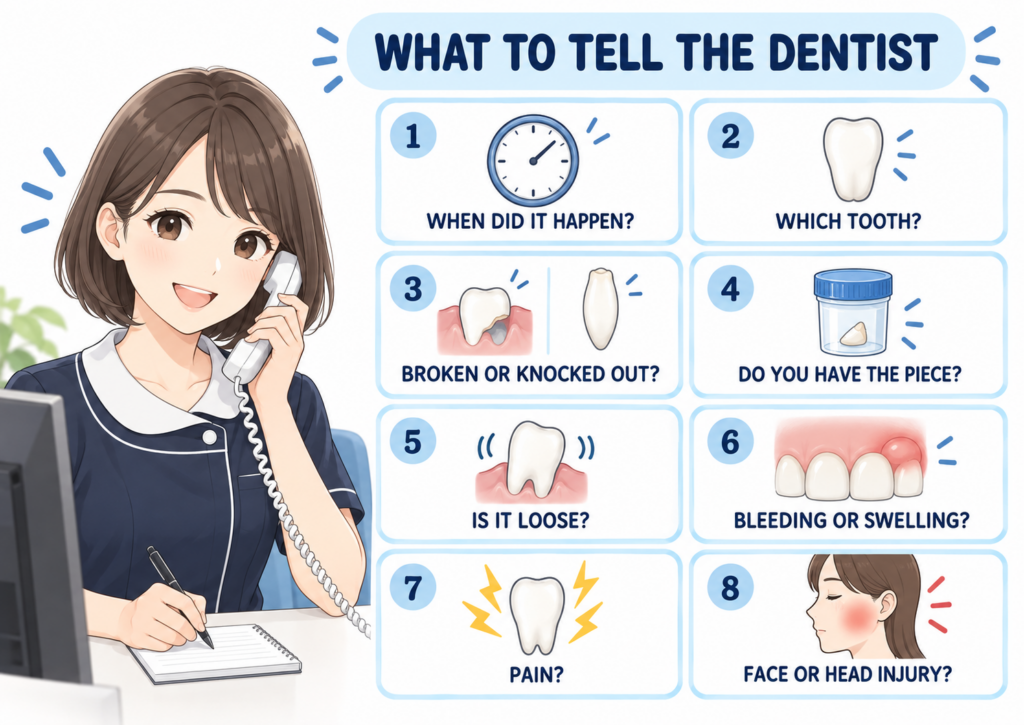
An English Sentence You Can Use When You Call
If you are nervous about calling a Japanese dental clinic in English, you can keep the first sentence very simple.
“I broke my front tooth about 30 minutes ago. I still have the broken piece. Can you see me today?”
If the tooth is moving:
“I fell and hit my mouth. One of my front teeth is loose and bleeding. Can I come in today?”
If you are not sure exactly what broke:
“Something broke off while I was eating. I’m not sure whether it was part of my tooth, a filling, or a crown. Can a dentist check it today?”
Other useful short phrases include:
- “It happened one hour ago.”
- “The tooth is loose.”
- “It is bleeding.”
- “I have the broken piece.”
- “The whole tooth came out.”
- “I do not have severe pain.”
- “I am staying in Hiroshima until tomorrow.”
Giving this basic information can make it easier for the clinic to understand the situation and decide how an appointment should be arranged.
Found the Broken Piece? Do Not Throw It Away
A surprisingly common reaction after a tooth breaks is to assume that the small piece is useless.
It may not be.
Depending on the shape and condition of the fragment, it may sometimes be possible to bond it back to the original tooth.
If you find a broken piece of tooth:
- do not throw it away
- do not scrub or file it
- do not use household glue
- keep it in a clean container
- if practical, keep it moist rather than allowing it to dry completely
- bring it to the dental clinic
Milk or saline can be used to keep a larger tooth fragment moist while you are arranging dental care. Saliva in a clean container is another practical option when nothing else is immediately available.
Do not try to attach the fragment to the tooth yourself. Household adhesives are not dental materials and may make proper treatment more difficult.
For a more general explanation of what to do when a tooth chips or breaks, see our Japanese article on same-day dental visits for a chipped tooth and what to tell reception before your appointment.
Can a Dentist Reattach the Broken Piece?
Sometimes, yes.
A suitable fragment may be bonded back to the tooth, but reattachment is not always possible or appropriate.
The dentist may need to consider:
- how deeply the tooth fractured
- whether the pulp is exposed
- whether the fracture extends below the gum
- whether the tooth is loose or displaced
- whether the root or surrounding bone has also been injured
- whether the fragment is intact and fits the remaining tooth
If the fragment cannot be used, composite resin or another treatment may be considered depending on the injury.
The important instruction for the patient is simple: if you find the piece, bring it and let the dentist decide whether it can be used.
Can’t Find the Broken Piece and Cut Your Lip or Cheek?
Tell the dentist.
When part of a tooth is missing after an impact and there is also a cut to the lip or cheek, the missing fragment should be accounted for. In some injuries, a tooth fragment or other foreign material can become embedded in the soft tissue.
Do not dig into the wound yourself trying to find it. Tell the dentist that the fragment is missing and that the lip or cheek was injured. The dentist can decide whether additional examination or imaging is appropriate.
It Doesn’t Hurt—Do I Still Need a Dentist?
A lack of pain does not necessarily mean that nothing important happened.
A dental injury can affect several different tissues. The visible crown may fracture, but the impact can also injure the tissues supporting the tooth, the pulp inside the tooth, the root, or the surrounding bone.
Some problems are obvious immediately. Others become clearer only after examination, X-rays, or follow-up.
After an injury, a tooth may:
- become slightly mobile
- move out of its normal position
- feel different when you bite
- change color later
- develop problems with the pulp later
- require follow-up even if the initial pain improves
This is why the seriousness of a dental injury should not be judged only by how much it hurts.
Our article on why a tooth may need follow-up even when it does not hurt after dental trauma explains this in more detail.
Red or Pink Inside the Broken Tooth? Tell the Dentist
If a tooth has fractured deeply enough to expose the pulp, you may see a small red or pink area in the center of the broken surface.
This may be accompanied by spontaneous pain, strong sensitivity, or sharp pain from cold air or drinks.
If you notice red or pink tissue inside the broken tooth, mention it when you call.
You do not need to touch the area to check what it is.
And the opposite is also important: not seeing anything red does not prove that the injury is minor. The depth of a fracture cannot always be judged accurately by looking at it in a mirror.
Is the Tooth Loose or Out of Position? Tell the Dentist
After a blow to the mouth, a tooth can be both fractured and displaced.
You may notice that:
- the tooth looks longer than before
- the tooth looks shorter
- it has moved toward the lip
- it has moved toward the tongue or palate
- it is tilted
- it moves when touched
- your teeth no longer meet normally when you bite
These details are important.
Do not repeatedly push the tooth back and forth to test how loose it is. Call the dentist and explain what you noticed.
A Broken Tooth and a Knocked-Out Tooth Are Not the Same Kind of Emergency
A broken or chipped tooth means that part of the tooth has fractured while some of the tooth remains in the mouth.
A completely knocked-out tooth, also called dental avulsion, means that the whole tooth has come out of its socket.
A completely knocked-out permanent tooth is one of the most time-sensitive dental injuries.
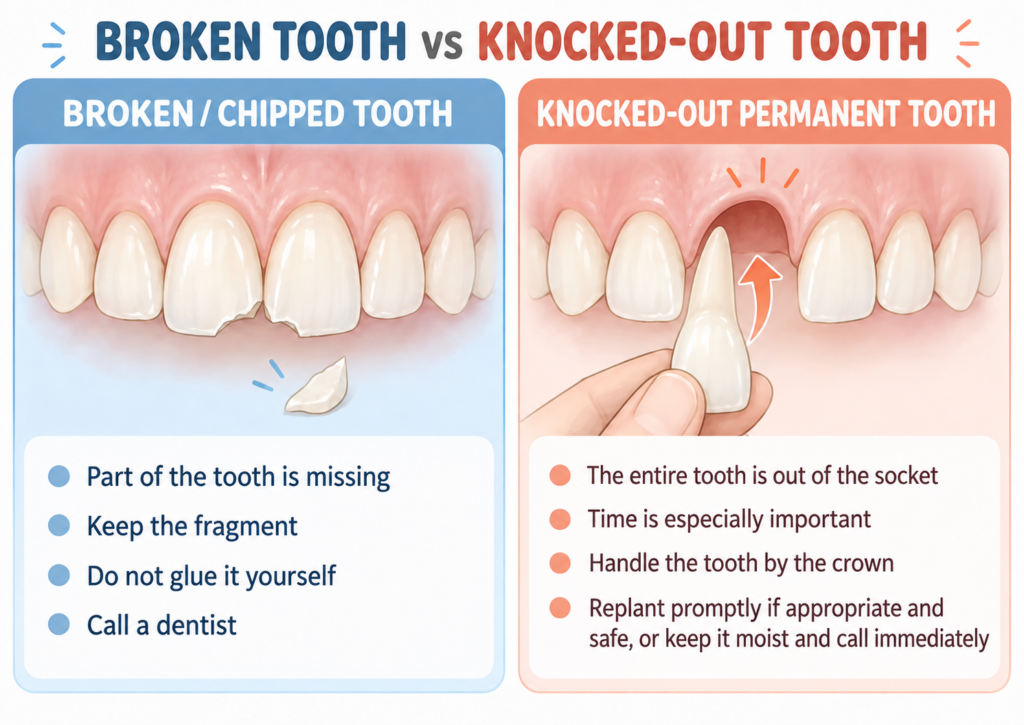
BROKEN TOOTH vs KNOCKED-OUT TOOTH
| BROKEN / CHIPPED TOOTH | KNOCKED-OUT PERMANENT TOOTH |
|---|---|
| Part of the tooth is missing | The entire tooth is out of the socket |
| Keep the fragment | Time is especially important |
| Do not glue it yourself | Handle the tooth by the crown |
| Call a dentist | Replant promptly if appropriate and safe, or keep it moist and call immediately |
If the Whole Permanent Tooth Came Out, Act Immediately
If an entire permanent tooth comes out after an injury, contact a dentist immediately.
For an avulsed permanent tooth, immediate replantation at the scene of the accident is generally the preferred first-aid option when it is appropriate and can be done safely.
First, Make Sure It Is a Permanent Tooth
A completely knocked-out baby tooth should not be replanted.
If the patient is a child and you are not sure whether the tooth is a baby tooth or a permanent tooth, contact a dentist immediately rather than guessing.
Pick the Tooth Up by the Crown, Not the Root
The crown is the white part that is normally visible in the mouth.
Avoid touching, scraping, or scrubbing the root.
If the Tooth Is Dirty, Rinse It Gently
If there is visible dirt on the tooth, it can be rinsed gently and briefly with milk, saline, or the patient’s own saliva.
Do not scrub the root with a toothbrush, cloth, or your fingers.
If You Are Certain It Is a Permanent Tooth and Can Replant It Safely
Place the tooth gently back into its original socket in the correct position and have the patient bite gently on clean gauze or a clean cloth to help hold it in place.
Then go to a dentist immediately, even if the tooth appears to be back in position.
If the patient is unconscious, unable to cooperate, there is a risk of swallowing or inhaling the tooth, or you are not confident that replantation can be performed safely, do not force it.
If You Cannot Replant It, Do Not Let It Dry Out
Place the tooth in a suitable storage medium as soon as possible.
- milk
- a dedicated tooth-preservation solution, if immediately available
- the patient’s saliva collected in a container
- saline
The important point is to avoid leaving the root surface dry while you search for dental care.
Do not store the tooth dry in a tissue or leave it exposed to the air.
Even if the tooth has already been dry for some time, do not assume that treatment is pointless. Bring the tooth and seek dental care promptly so that the dentist can assess the situation.
Never Replant a Knocked-Out Baby Tooth Yourself
A knocked-out primary tooth should not be replanted because replantation can create additional risks, including damage to the developing permanent tooth underneath.
When Is It More Than a Dental Emergency?
Most isolated chipped or broken teeth do not require an ambulance.
But sometimes a broken tooth is only one part of a more serious injury.
Seek emergency medical help rather than relying only on a routine dental appointment if there is:
- difficulty breathing
- loss of consciousness
- confusion, unusual drowsiness, or other concerning symptoms after a head injury
- severe facial trauma
- a suspected major jaw fracture
- uncontrolled heavy bleeding
- rapidly worsening swelling that interferes with breathing or swallowing
In Japan, the emergency ambulance number is 119.
If the accident involved your face or head as well as your teeth, tell the healthcare provider about the entire accident, not only the broken tooth.
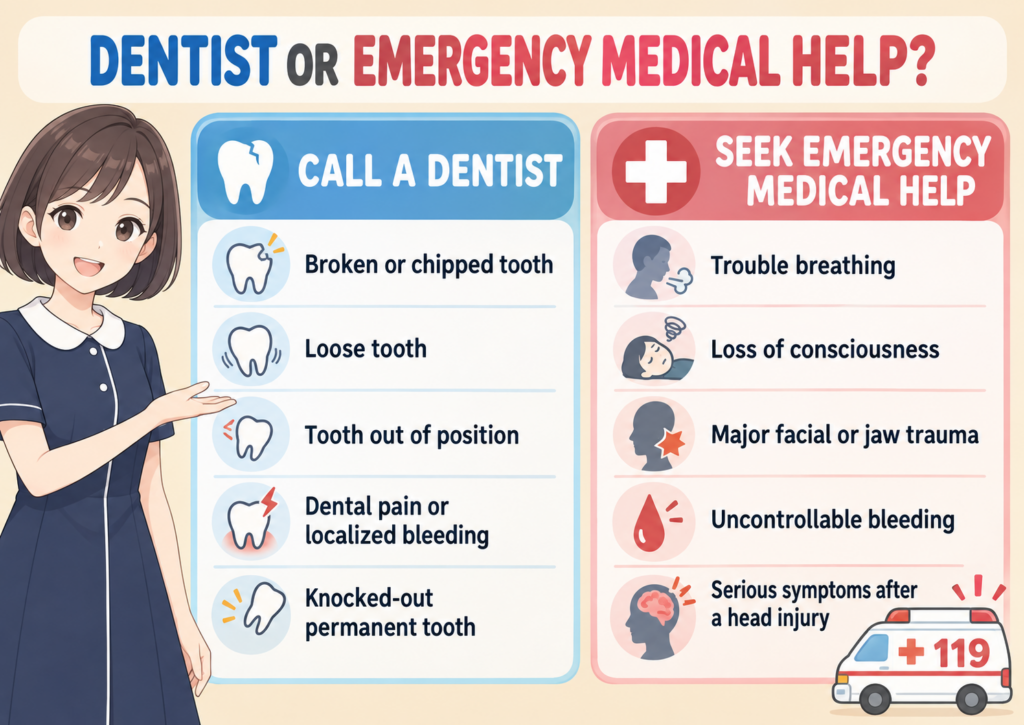
DENTIST OR EMERGENCY MEDICAL HELP?
| CALL A DENTIST | SEEK EMERGENCY MEDICAL HELP |
|---|---|
| Broken or chipped tooth | Trouble breathing |
| Loose tooth | Loss of consciousness |
| Tooth out of position | Major facial or jaw trauma |
| Dental pain or localized bleeding | Uncontrollable bleeding |
| Knocked-out permanent tooth | Serious symptoms after a head injury |
What Will the Dentist Check?
Patients sometimes hesitate to make an urgent appointment because they are unsure what a dentist can actually do on the first visit.
The examination is not simply about “filling the missing part.” The dentist first needs to determine exactly which structures were injured.
Depending on the situation, the assessment may include:
- asking when and how the injury happened
- checking the fractured surface
- checking whether the tooth is loose
- checking whether the tooth has moved
- examining the gums, lips, and surrounding tissues
- checking your bite
- testing the tooth when appropriate
- taking dental X-rays when necessary
- assessing whether the root or surrounding bone may be involved
Not every patient needs every test. A small uncomplicated fracture and a tooth that is fractured, displaced, and bleeding require different assessments.
For readers who want a broader explanation of dental trauma itself, our Japanese article on what happens when a tooth is hit or injured explains the main types of dental trauma in more detail.
Will My Tooth Be Completely Fixed Today?
Maybe—but not always.
This is one of the most important differences between a same-day appointment and same-day completion of treatment.
Depending on the diagnosis, treatment on the day may include:
- smoothing a sharp fractured edge
- protecting exposed dentin
- composite resin restoration
- reattaching a suitable tooth fragment
- temporary protection
- treatment to protect or manage an exposed pulp
- repositioning or stabilizing an injured tooth
In other cases, the first visit may focus on diagnosis and emergency management, with additional treatment scheduled later.
Further care may involve:
- additional restorative treatment
- pulp-preserving treatment
- root canal treatment
- stabilization and follow-up
- additional imaging
- prosthetic treatment
- oral surgery assessment
- extraction when the tooth cannot reasonably be saved
So when a dental clinic says that it may be able to “see you today,” it means that the clinic can assess the injury and decide on the appropriate next step. It does not mean that every broken tooth can be completely restored in one visit.
What Should Foreign Visitors Bring to a Dentist in Japan?
If you are visiting Japan and suddenly need dental treatment, do not worry if you do not have a complete set of documents with you.
Call the clinic first and ask what is needed.
Useful items may include:
- identification such as your passport
- travel insurance information
- your insurer’s contact details
- a list or photos of medications you take
- information about allergies and important medical conditions
- the broken tooth fragment or knocked-out tooth
- previous dental information, if it is readily available
If you have travel insurance, remember that dental coverage varies between policies. Some policies may cover dental treatment caused by an accident, some may cover only limited emergency treatment, and others may exclude particular types of dental care.
A dental clinic cannot guarantee what your insurer will reimburse.
If your insurer requires an itemized receipt, treatment certificate, medical report, or other documentation, ask the dental reception desk as early as possible. The types of documents that can be prepared, any related fees, and the time needed to prepare them may vary.
However, if the injury is urgent, do not delay contacting a dentist for hours simply because you cannot find every insurance document.
What If I Live in Japan and Have Japanese Health Insurance?
If you are enrolled in Japanese public health insurance, the documents used to confirm insurance eligibility changed from the old health insurance card system.
As of September 2026, patients should generally present either:
- a My Number Card registered for health insurance use (often called a “Myna Insurance Card” in Japan); or
- a Health Insurance Eligibility Certificate(資格確認書), if applicable.
The temporary grace period for using expired old-style health insurance cards ended on July 31, 2026.
If your insurance status has recently changed, or you are unsure which document applies to you, tell the receptionist when you make the appointment.
Japanese public health insurance also does not mean that every possible dental treatment is automatically covered. Some dental treatments are covered by public insurance, while others may be private treatment.
For a more detailed explanation, see our English article I Have National Health Insurance—Why Do I Have to Pay the Full Cost of My Dental Treatment?
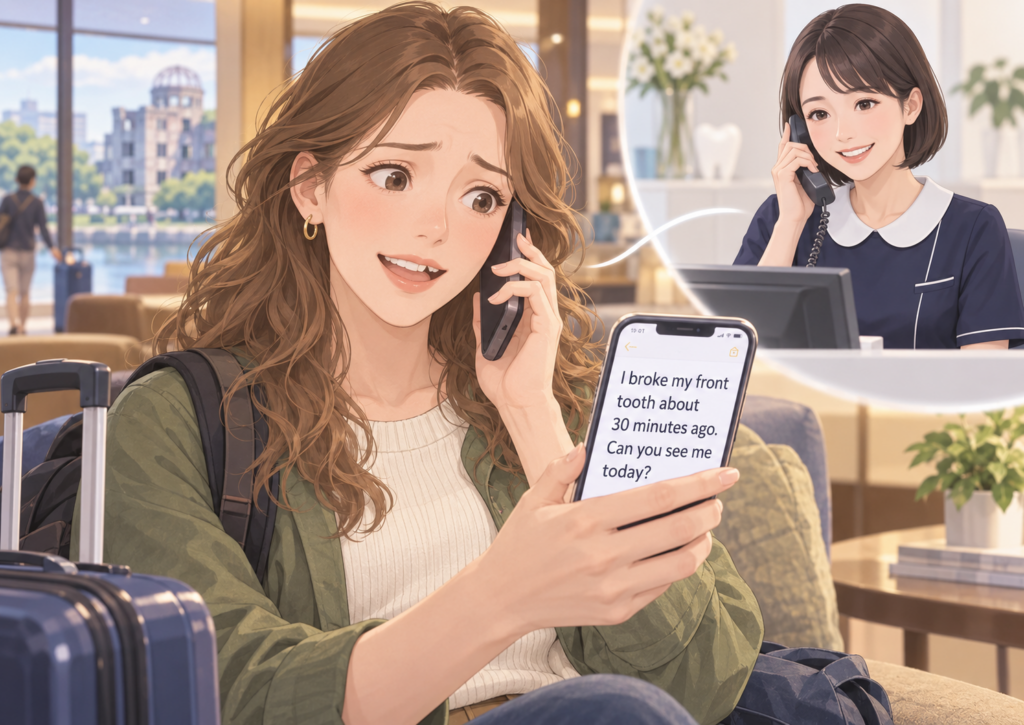
I Don’t Speak Japanese—Can I Still Call a Dentist?
Yes.
Language support varies between dental clinics in Japan, so it is helpful to say at the beginning of the call that you prefer English.
You can start with:
- “Do you speak English?”
- “I broke a tooth.”
- “It happened one hour ago.”
- “The tooth is loose.”
- “I still have the broken piece.”
- “Can you see me today?”
If speaking by telephone is difficult, a hotel employee, friend, family member, employer, school staff member, or another person may be able to help explain the situation.
Do not let embarrassment about your Japanese ability stop you from seeking help for an important dental injury.
If You Need Help Finding Medical Care in Japan
If you are traveling elsewhere in Japan and are unsure where to seek help, the Japan National Tourism Organization operates the Japan Visitor Hotline 24 hours a day, 365 days a year.
Support is available in English, Chinese, and Korean for accidents, illness, emergencies, and general tourist assistance.
- Within Japan: 050-3816-2787
- From overseas: +81-50-3816-2787
This service does not replace a dental examination, but it may be useful for visitors who need help navigating medical services in Japan.
Tourist, Business Traveler, or Resident—Tell Us Your Schedule
A dentist may also need to know how long you will remain in Hiroshima or Japan.
For example:
- “I leave Hiroshima tomorrow.”
- “I return home in three days.”
- “I am traveling to another city tomorrow.”
- “I am in Japan for another two weeks.”
Your travel schedule does not change the diagnosis, but it can affect how treatment and follow-up are planned.
Some dental injuries require several visits or later reassessment. If you are leaving Japan soon, the immediate goal may sometimes be to diagnose the injury, protect or stabilize the tooth, control pain, and explain what treatment should continue at your next destination rather than trying to fit complex treatment into a single appointment.
Tell the dentist your departure date early. It can be useful information when planning care.
If You Are in Hiroshima, How Do You Reach Blanc Dental Clinic?
Blanc Dental Clinic is located in central Hiroshima, approximately one minute on foot from Tatemachi tram stop.
The clinic is on the 4th floor of Tatemachi Chuo Building, with elevator access. Sukiya on the 1st floor is an easy landmark when looking for the building.
Hatchobori, Kamiyacho, and Hondori are also within walking distance.
If you are coming from Hiroshima Station or another part of the city center, see our guide to reaching Blanc Dental Clinic from Hiroshima Station, Kamiyacho, Hatchobori, and Hondori.
For a broken or injured tooth, calling is recommended if you need a same-day appointment. Same-day urgent consultation may be possible depending on the appointment schedule and the condition.
WEB and LINE are convenient for ordinary appointment requests, but when a tooth has just broken, moved, or come out, a telephone call makes it easier to explain what happened, when it happened, and how urgent the problem may be.
What Should I Do While Waiting for the Appointment?
Once you have contacted the dental clinic, avoid doing anything that could make the injury worse.
Keep the Broken Piece
Bring the fragment with you and keep it moist if possible.
Do not glue it back yourself.
Avoid Hard Chewing on the Injured Tooth
Choose softer foods if you need to eat before your appointment and avoid biting directly on the injured tooth.
Do Not File the Tooth Yourself
A sharp edge can be uncomfortable, but trying to grind or file the tooth at home can remove healthy tooth structure or make the situation more difficult to treat.
Do Not Keep Testing a Loose Tooth
Repeatedly pushing or moving the tooth does not help determine the diagnosis. Leave it as undisturbed as possible until it can be examined.
If There Is Bleeding, Apply Gentle Pressure
For localized bleeding inside the mouth, gentle pressure with clean gauze may help while you are arranging care.
If bleeding is heavy and cannot be controlled, or if the injury is associated with significant facial or head trauma, seek appropriate emergency medical help.
FAQ: Broken Tooth and Dental Care in Japan
Can I Walk Into a Dentist in Japan Without an Appointment?
Some dental clinics may accept walk-in patients, but availability varies. For a broken or injured tooth, calling before you arrive is usually better because the clinic can ask what happened and check whether a same-day appointment is possible.
Can a Dentist Fix a Broken Tooth in One Visit?
Sometimes. A relatively uncomplicated fracture may sometimes be restored during one appointment, while a deeper fracture, exposed pulp, loose tooth, root injury, or fracture below the gum line may require additional treatment or follow-up.
Should I Keep a Tiny Broken Piece of Tooth?
Yes. Do not throw it away. Keep it in a clean container, preferably moist if practical, and bring it to the dentist because it may sometimes be useful for treatment.
What If the Broken Piece Is Missing and My Lip Is Cut?
Tell the dentist. In some injuries, a missing tooth fragment can become embedded in the lip or cheek, and the dentist may decide that additional examination or imaging is needed.
What If My Broken Tooth Does Not Hurt?
It may still need assessment. Pain alone cannot determine whether the pulp, root, supporting tissues, or surrounding bone has been injured.
What If My Entire Permanent Tooth Came Out?
Act immediately. Handle the tooth by the crown, avoid scrubbing the root, and if you are certain it is a permanent tooth and can safely do so, immediate replantation is generally preferred. If you cannot replant it, keep it moist in an appropriate medium such as milk and contact a dentist immediately.
Should I Put a Knocked-Out Baby Tooth Back In?
No. A knocked-out baby tooth should not be replanted by the parent or patient.
Can I See a Dentist in Japan If I Don’t Speak Japanese?
Yes, although the level of English-language support varies by clinic. Tell the receptionist that you prefer English and describe the problem using simple sentences.
Does Travel Insurance Cover a Broken Tooth in Japan?
It depends on your policy. Dental treatment after an accident may be covered under some plans, while other dental treatment may be limited or excluded. Check directly with your insurance company.
Do I Need Japanese Health Insurance to See a Dentist?
No. Japanese public health insurance affects how eligible treatment is billed, but it is not a requirement simply to contact a dental clinic and request care. Short-term visitors can also receive dental treatment, although payment and insurance reimbursement procedures may differ.
Can I Wait Until I Return Home?
That depends on the injury. A very small superficial chip and a loose, displaced, deeply fractured, or completely knocked-out tooth are not equivalent situations. If the injury has just happened, contact a dentist rather than deciding to wait based only on whether it hurts.
Broke a Tooth in Hiroshima? Call Before You Come
Breaking a tooth in another country can be stressful, especially when you are unsure how appointments, insurance, and language support work.
But you do not need to diagnose the injury yourself before contacting a dentist.
If a tooth breaks while you are in Hiroshima:
- Keep the broken piece if you can find it.
- Remember when the injury happened.
- Check whether the tooth is still present, loose, displaced, or completely knocked out.
- Tell the dental clinic about bleeding, swelling, pain, movement, and any facial or head injury.
- If the whole permanent tooth came out, act immediately.
- Call before coming if you hope to be seen the same day.
- Bring your identification, insurance information, medication information, and the broken piece or tooth when available.
Blanc Dental Clinic is approximately a one-minute walk from Tatemachi tram stop in central Hiroshima. We are on the 4th floor of Tatemachi Chuo Building, with elevator access, and Sukiya on the 1st floor is an easy landmark.
Same-day urgent consultations may be possible depending on the appointment schedule and the condition. If your tooth has broken, moved, or come out, please call us and tell the receptionist what happened and when it happened.
We can then consider the urgency of the situation and whether a same-day visit can be arranged.
References
- 公益社団法人日本口腔外科学会・日本口腔顎顔面外傷学会. 口腔顎顔面外傷診療ガイドライン 2025 改訂版.
- Bourguignon C, Cohenca N, Lauridsen E, et al. International Association of Dental Traumatology guidelines for the management of traumatic dental injuries: 1. Fractures and luxations. Dental Traumatology. 2020;36:314-330.
- Fouad AF, Abbott PV, Tsilingaridis G, et al. International Association of Dental Traumatology guidelines for the management of traumatic dental injuries: 2. Avulsion of permanent teeth. Dental Traumatology. 2020;36:331-342.
- Day PF, Flores MT, O’Connell AC, et al. International Association of Dental Traumatology guidelines for the management of traumatic dental injuries: 3. Injuries in the primary dentition. Dental Traumatology. 2020;36:343-359.
- International Association of Dental Traumatology. 2020 IADT Guidelines for the Evaluation and Management of Traumatic Dental Injuries.
- NHS. Chipped, broken or cracked tooth.
- Ministry of Health, Labour and Welfare, Japan. Information on verifying health insurance eligibility at medical institutions and pharmacies.
- Ministry of Health, Labour and Welfare, Japan. My Number Card as your Health Insurance Certificate: Foreign Language Materials.
- Japan National Tourism Organization. Japan Visitor Hotline.